A sovereigntist premier, a vanished governing party, a Conservative breakthrough and a seat count that rewards a narrow vote share have reshaped Quebec politics overnight, with consequences that reach Ottawa.
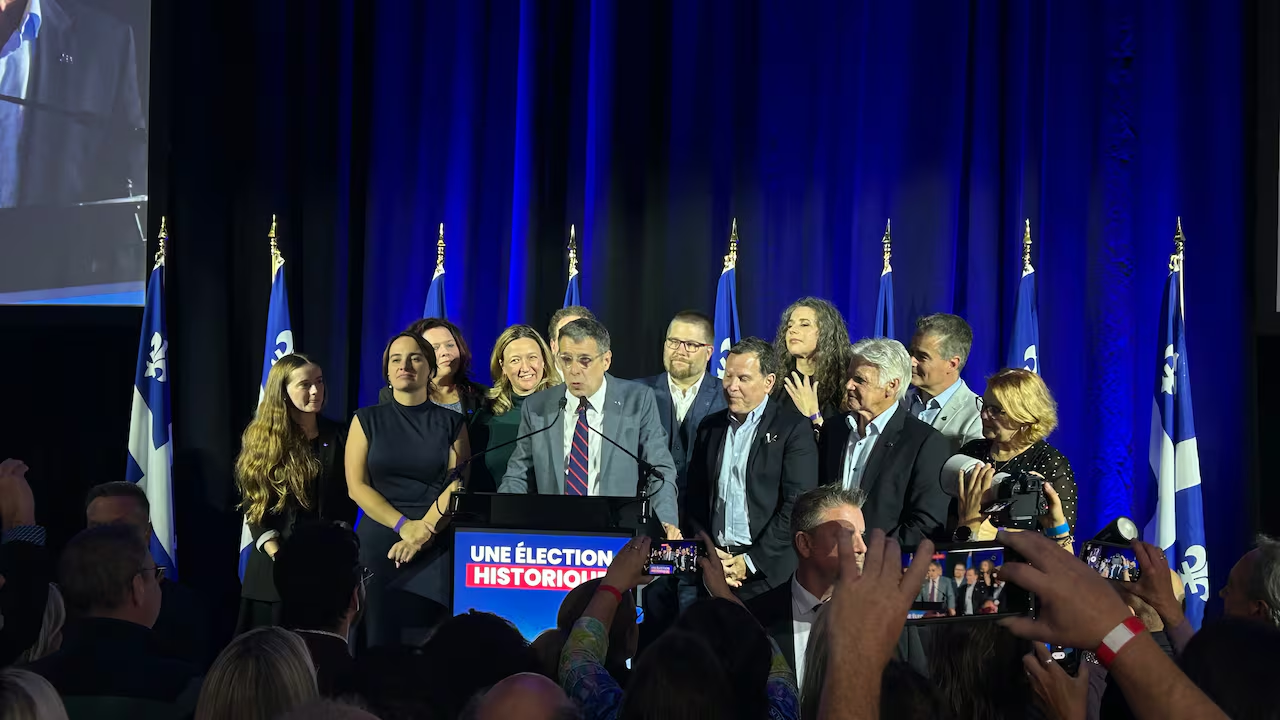
The Quebec election 2026 has handed the Parti Québécois a minority government and made Paul St-Pierre Plamondon the province’s next premier, according to projections released late on Monday, October 5. The sovereigntist party won with less than 30 per cent of the popular vote. The governing Coalition Avenir Québec was erased from the National Assembly, and its leader, Christine Fréchette, lost her own riding.
The result redraws Quebec’s political map in a single night. It returns the PQ to power for the first time since Pauline Marois led the party to government in 2012. It also revives a debate about Quebec’s place in Canada that federal leaders had not faced in years, and it is likely to bring renewed pressure to change how Quebecers elect their legislature.
Where the Quebec Election 2026 Seat Count Landed
Projections late on election night placed the PQ at 59 seats, five short of the threshold for a majority. The Liberals finished a distant second, and the Conservatives took third after entering the campaign with no seats at all.
| Party | Leader | Projected seats | Notable result |
|---|---|---|---|
| Parti Québécois | Paul St-Pierre Plamondon | 59 | Minority government on under 30% of the vote |
| Quebec Liberal Party | Charles Milliard | 40 | Up from 18; Milliard projected to win Orford |
| Conservative Party of Quebec | Éric Duhaime | 19 | Up from zero in 2022; Duhaime projected to win Bellechasse |
| Québec solidaire | Ruba Ghazal (co-leader) | 9 | Ghazal projected to win Mercier |
| Coalition Avenir Québec | Christine Fréchette | 0 | Leader defeated in her own riding |
The figures were projections at the time of reporting. Final counts can still shift in individual ridings. The campaign featured 908 candidates across the province.
How Four Years Took the CAQ From Landslide to Zero
The scale of the CAQ’s collapse is the night’s most striking result. In 2022 the party won a sweeping majority with 41 per cent of the popular vote, which translated into 71 per cent of the seats in the National Assembly. Four years later it is projected to hold none.
Fréchette, who led the party into this campaign, took personal responsibility for the defeat in her concession speech. The loss of her own seat leaves the party with no leader in the legislature and no caucus to rebuild around. That is a rare outcome for a party that governed with a large majority a single term earlier.
St-Pierre Plamondon’s Two Messages: Cooperation and a Country
The incoming premier’s victory speech carried two messages that will define his minority government. He pledged to work with the other parties in the legislature. He also told Prime Minister Mark Carney that he would be “direct” and “transparent” in his dealings with Ottawa.
He closed, however, by reaffirming the PQ’s founding goal. St-Pierre Plamondon told supporters he still dreams of making Quebec a country and urged other sovereigntists in the National Assembly to back that aim. “We are the only people who should be able to determine our destiny,” he told the cheering crowd.
He also spoke directly to English-speaking Quebecers. He said residents across the province face the same challenges regardless of language and that he wants to solve those problems together. For a party long viewed warily by many anglophone voters, the gesture was a notable part of the speech.
Milliard’s Liberals Rule Out Any Help on a Referendum
The Liberals more than doubled their presence in the legislature. “Now instead of 18 MNAs, there are 40 of us,” Milliard told supporters in Magog, beneath the party slogan “Rassembler. Réparer. Bâtir,” or “Unite. Repair. Build.” He said the party had offered a clear plan on public finances, housing, education and health care.
Milliard said voters had chosen a legislature with no majority, so the PQ would be obliged to weigh ideas from other parties. The Liberals, he said, would review PQ proposals on whether they serve the province’s interests. On sovereignty, though, he drew a firm line.
- On a referendum: Milliard warned that preparing one would bring the PQ face to face with “a clear opponent” in the Liberal Party.
- In English: He said the Liberals would cooperate on many issues, but “there is no way we will collaborate on a potential referendum.”
- At headquarters: Asked about a referendum, his answer was a blunt “No way.”
For more on how sovereignty is shaping the new legislature, see our earlier report on how the result puts a third referendum back on the table.
A Speech-Order Snub on Election Night
The tension between the PQ and the Liberals surfaced before the night was over. By convention, the runner-up addresses supporters before the winner. St-Pierre Plamondon instead took the stage ahead of Milliard, who had been scheduled to speak after Duhaime.
A Liberal source said the PQ leader knew the planned order but went ahead anyway, to the frustration of Liberal staff and supporters. Milliard filled the time by speaking with media, candidates and supporters before delivering his own address. He referred to the slight directly: “Mr. St-Pierre Plamondon, you spoke before me, but I want to speak to you.”
Duhaime’s Conservatives Finally Break Through
The Conservatives had one of the best nights of any party, jumping from zero seats in 2022 to a projected 19. Duhaime, who campaigned on tax and spending cuts, is projected to win Bellechasse and will now sit in the National Assembly. During the campaign he also pitched his party as a “credible alternative” for anglophone voters.
The party’s gains included a symbolic win in Arthabaska-L’Érable. Conservative Tarek Henoud is projected to take the riding from the PQ’s Alex Boissonneault. Henoud had run there for the Conservatives in 2022 and stepped aside for Duhaime in a 2025 byelection. Duhaime lost that contest to Boissonneault on what was his third attempt to win a seat in the legislature.
The Outaouais Swings Back to the Liberals, With One PQ Exception
In western Quebec, the traditionally Liberal ridings of Pontiac, Hull, Gatineau, Chapleau and Papineau largely returned to form. The Liberals are projected to win four of the five. Voters there had backed the CAQ in 2022, partly to keep the sovereigntist PQ out of power. This time they turned away from the CAQ.
The exception was Papineau, where the PQ is projected to win for the first time since 1976. PQ candidate Isabelle Millette, cheered in a local bar after her projected victory, said she looks forward to working with the Liberals. “Their priorities are similar to ours,” she said, adding that she wants to make sure the region is “not forgotten” in the National Assembly.
Liberal candidates in the region said health care and education remain their main priorities, issues the area has struggled with for years. Michel Langevin, projected MNA-elect in Chapleau, said he was eager to start work but would need to figure out how to do that under a PQ government.
Why a Sub-30% Win Puts Quebec Electoral Reform Back on the Agenda
A party forming government with less than three in ten votes is likely to sharpen an old debate. The PQ, Québec solidaire and the Conservatives all campaigned on replacing the current first-past-the-post system with a proportional method. Such a system aims to align each party’s share of seats more closely with its share of the vote. St-Pierre Plamondon promised reform would be on his government’s agenda.
Quebec has heard such pledges before. Former premier François Legault promised electoral reform when he ran as CAQ leader in 2018, then dropped the commitment in 2021 while in office. Former prime minister Justin Trudeau made a similar promise for federal elections and never delivered.
The two most recent results illustrate the gap reform advocates point to:
- 2022: The CAQ won 41 per cent of the vote and 71 per cent of the seats.
- 2026: The PQ is projected to form government with less than 30 per cent of the vote.
Whether a minority government can build cross-party support for a new system is an open question. With three parties on record supporting proportional voting, the arithmetic in the new legislature is more favourable to reform than it has been in recent years.
Fifty Years After Lévesque: The PQ’s Sovereignty History
The victory arrives close to the 50th anniversary of the party’s first win. On November 15, 1976, René Lévesque led the PQ to 71 of the National Assembly’s 110 seats with a mandate to hold a referendum on sovereignty. That vote came in 1980 and drew about 40 per cent support.
Like Lévesque, St-Pierre Plamondon takes office with sovereignty at the core of his party’s identity. Unlike Lévesque, he governs without a majority. Any major initiative will need support from at least some MNAs outside his caucus.
What a PQ Government Means for Carney and the Federation
Carney congratulated St-Pierre Plamondon on election night. The relationship between the two will be closely watched. The prospect of a Quebec referendum has been largely absent from federal politics for more than a decade.
The PQ leader has said his party will wait until U.S. President Donald Trump leaves office before holding a referendum. Political observers caution that the timing should not be mistaken for a weakened commitment to independence. Polling cited during the campaign suggests only about 30 per cent of Quebecers want a referendum, yet the PQ treats the goal seriously.
The result also comes at a sensitive moment for intergovernmental relations. Premiers have presented a united “Team Canada” front in responding to the trade war with the United States. A sovereigntist government in Quebec City could make that coalition harder to hold together. Carney now faces the task of showing Quebec it is valued within the federation without fuelling a separatist movement that is no longer dormant.
For context on how the race unfolded, revisit our coverage of the polls that kept the Parti Québécois in front and the leaders’ final pitches before voting day. Seat totals above reflect election-night projections and may change as final results are confirmed.

The Brand Magazine Newsroom covers Canadian business, markets and policy news for brand builders and entrepreneurs. Newsroom reports are produced from published public sources such as company releases and government and regulator publications, and follow our Editorial Standards.