What Canada's foreign minister actually committed to at the General Assembly — from strategic autonomy and middle-power alliances to NATO, the Arctic and the ICC.
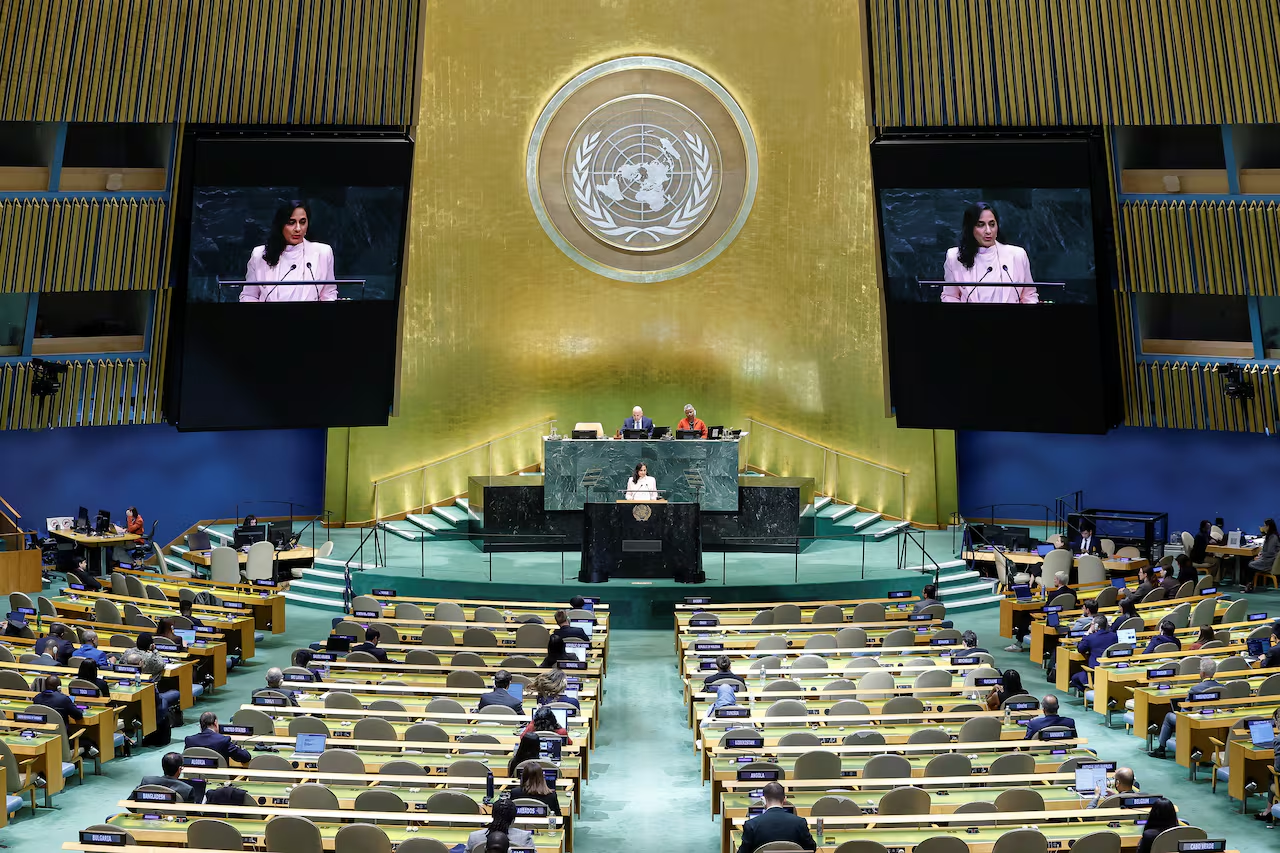
The Anand UN address delivered on Saturday, Sept. 26, 2026, put a single phrase at the centre of Canadian foreign policy: strategic autonomy. Speaking from the General Assembly’s green marble dais in New York, Foreign Affairs Minister Anita Anand argued that Canada’s aim is to build independent capacity in the fields that decide a country’s leverage — and to do it alongside other middle powers rather than in the shadow of any superpower.
Her framing was pointed without being personal. “Great powers are walking away from global economic co-operation, dismantling economic integration,” she told delegates, without naming which ones. It was the sharpest line in a speech that otherwise stayed carefully inside the language of rules, sovereignty and collective action.
What Anand Meant by “Strategic Autonomy”
Anand defined the concept in practical terms rather than abstract ones. Canada’s push for greater autonomy, she said, runs through emerging technologies, critical minerals, defence production and energy — the four supply chains where dependence translates most directly into political vulnerability.
She paired those industrial files with two legal ones: the rule of law and respect for sovereignty. The argument, in effect, is that a mid-sized economy protects itself both by controlling what it makes and by defending the rules that stop larger states from simply taking what they want.
To make the point land, Anand reached for an image from her upbringing in rural Nova Scotia. “The tide does not wait; you must move with it,” she said — a line that framed adaptation, not nostalgia for the old order, as Canada’s position.
The Great-Power Critique She Made — and the Subject She Left Alone
What Anand did not say was as newsworthy as what she did. The speech contained no direct reference to U.S. tariffs and no mention of the breakdown in Canada–U.S. trade negotiations, even as she described great powers dismantling economic integration.
Instead she pushed the trade file forward positively, stressing diversification beyond North America — the continuation of a year of Canadian outreach to Europe, Asia and other non-traditional partners. The omission fits a pattern critics have flagged before: Ottawa pressing its case in multilateral language while avoiding a named confrontation with Washington.
That restraint is now itself contested territory at home. The same criticism has followed Ottawa through other security debates this year, including the moment Prime Minister Mark Carney’s remarks on contingency planning put Canada–U.S. risk assumptions in public view.
How the Speech Tracks Carney’s Middle-Power Doctrine
Anand’s text echoed the argument Carney has been making for roughly a year: that middle powers should deepen ties with one another, including with states that are not close partners, to build the framework of whatever order replaces the current one.

“We will lead other middle powers to act collectively and decisively,” she said, describing that new international order as something “being established as we speak.” It is an unusually forward claim for a Canadian UN address — less a defence of the existing system than an assertion that Canada intends to help write the successor.
For Canadian business readers, the practical content of that doctrine is the diversification agenda: new trade corridors, critical-minerals partnerships, defence-industrial capacity and technology standards negotiated with partners other than the United States.
NATO, the Denmark–Greenland–U.S. Deal and Canada’s Arctic
Anand reaffirmed Canada’s place in NATO at a moment when European leaders have been escalating warnings about Russian hybrid attacks. She called Canada’s commitment to the transatlantic alliance “ironclad,” noting the country’s status as a founding member.
She cited the recent defence agreement between Denmark, the autonomous territory of Greenland and U.S. President Donald Trump as evidence that “North America and Europe are stronger together” — a notable choice, given how contentious Greenland’s status has been in transatlantic politics.
On the domestic side of the same file, Anand said work to secure the Canadian Arctic is proceeding in lockstep with Indigenous Peoples. That work sits alongside a fast-changing physical environment in the North, where federal climate projections have warned of warming scenarios reaching 5°C by 2100, reshaping shipping routes and access alike.
Ukraine, Palestinians and Israelis: Where Canada Drew Its Lines
Anand said state sovereignty “has been treated with disdain” and committed Canada to defending the principle and working toward stability and common rules. From that premise she set out three positions:
- A just peace in Ukraine: alongside a call for the return of Ukrainian children abducted by Russia.
- Self-determination for Palestinians and Israelis: framed as a single commitment rather than a choice between the two.
- An end to hate-based violence: presented as a global obligation, not only a foreign-policy one.
The speech also touched on gender equality, LGBTQ+ rights, Sudan’s civil war, Hamas attacks on Israel, Israeli settler violence against Palestinians, and safe approaches to artificial intelligence — a wide sweep typical of Canada’s General Assembly slot.
The Belleville Synagogue Attack and Anand’s Civility Argument
Anand brought the hate-violence theme home directly, telling the Assembly that Canadians “were tragically reminded of the scourge of antisemitism again” when a gunman attacked a synagogue in Belleville, Ont.

She followed it with a description of Canada as “an open, pluralistic society, with a public square full of robust and civil debate,” crediting that civility, democratic institutions and respect for difference for the country’s success. Placing a domestic attack inside a speech about the global order was a deliberate rhetorical move: the argument that internal cohesion is part of a country’s external strength.
Backing the ICC While Washington Works to Dismantle It
Anand stated Canada’s support for the International Criminal Court at a time when the United States is pursuing the institution’s dismantling. The comment carries added weight in Canada because Washington has sanctioned a Canadian judge over her work at the court — a case domestic critics cite when arguing Ottawa has been too quiet about American coercion.
She described the government’s overall approach as “values-based realism,” and applied it to advocating for democracy in Iran and to international efforts to end Haiti’s gang crisis. She also restated Canada’s campaign for a seat on the UN Human Rights Council, with the vote expected in about a year.
On the succession at the top of the UN, Anand said Canada is prepared to work with whoever member states elect as the next secretary general, referring in French to both the masculine and feminine forms of the title. The Trudeau government had explicitly called for a woman in the role in September 2024; the Carney government has not repeated that call.
Why Carney Skipped the Podium for a Second Year
For the second consecutive year, Anand delivered Canada’s address in the prime minister’s place. Carney was at the UN from Monday to Wednesday during high-level week, but his officials said scheduling issues prevented him from giving the speech himself.
The UN’s own rotation explains part of the outcome. Weekday daytime slots are reserved for heads of state and government, with foreign ministers scheduled later in the week — which is why Canada’s turn came late on a Saturday afternoon, one of the quieter windows of the session. The trade-off is real: a smaller live audience, but a text that still enters the permanent record of the Assembly and sets the reference point for Canadian diplomacy over the coming year.
Frequently Asked Questions
What does “strategic autonomy” mean in Canada’s case?
As Anand described it, building independent Canadian capacity in emerging technologies, critical minerals, defence production and energy, so that superpowers have less scope to apply coercive pressure.
Did Anand mention U.S. tariffs or the collapsed Canada–U.S. trade talks?
No. She criticized great powers for retreating from economic cooperation but did not name the United States, tariffs, or the trade negotiations.
Why did the foreign minister speak instead of the prime minister?
Carney attended the UN earlier in the week, but his officials cited scheduling issues. The UN also reserves weekday daytime speaking slots for heads of state and government, placing foreign ministers later in the rotation.
When is the vote on Canada’s Human Rights Council bid?
Anand said the vote is expected in about one year. No specific date was given in the address.

The Brand Magazine Newsroom covers Canadian business, markets and policy news for brand builders and entrepreneurs. Newsroom reports are produced from published public sources such as company releases and government and regulator publications, and follow our Editorial Standards.