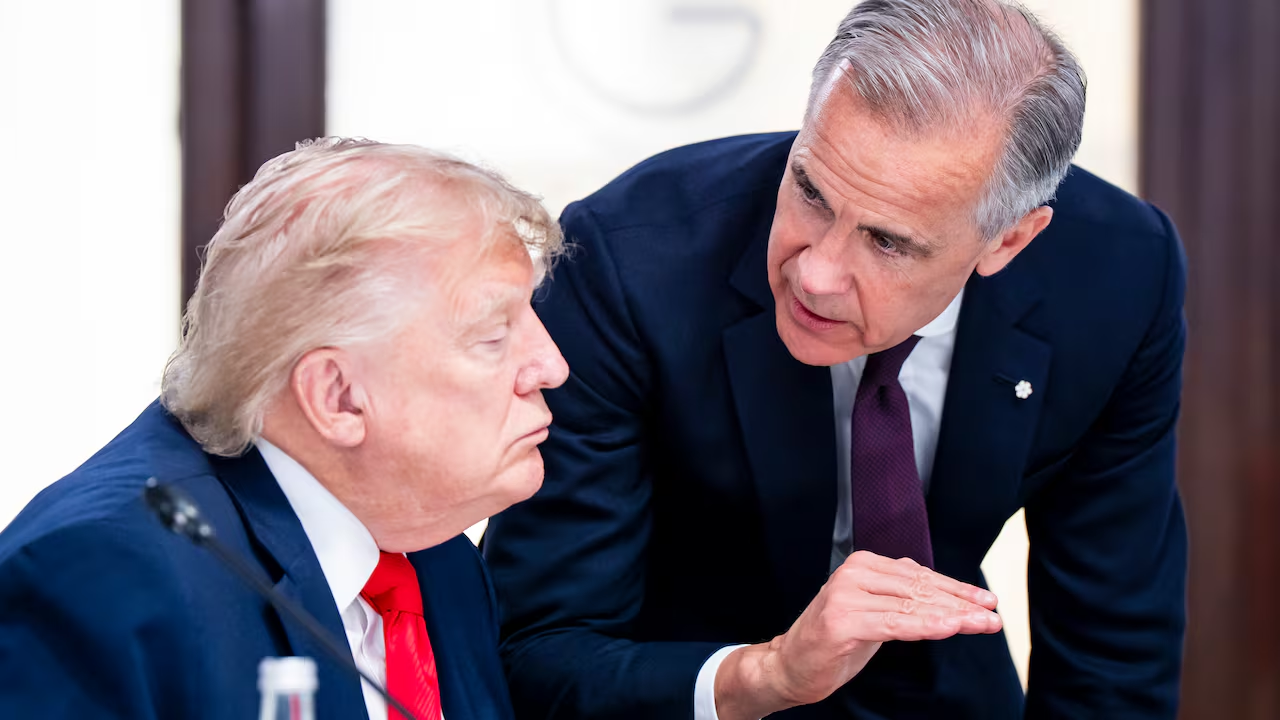
What the prime minister actually said about an American military scenario, why defence planners keep such files, and how Ottawa and Washington are reading the moment.
The Carney U.S. invasion risk comments that surfaced this week have done something unusual in Canadian politics: they turned a routine, rarely discussed function of the Department of National Defence into front-page material. In an interview with the New York Times published Wednesday, Prime Minister Mark Carney said he had prepared for the “extreme tail risk” that the Trump administration might order military action against Canada — a phrase that, in the language of a former central banker, means a probability very close to zero, but not zero.
By Thursday the remark had travelled from a newspaper interview to the floor of the House of Commons, drawn a response from Defence Minister David McGuinty, and been publicly dismissed by a senior American commander. It also reopened a question Canadians have been circling since Donald Trump began calling the country the 51st state: how seriously is Ottawa treating the rhetoric behind closed doors?
The “Extreme Tail Risk” Phrase and What Carney Would Not Say
Pressed on whether he took Trump’s threats to absorb Canada seriously, Carney suggested to the Times that he had carefully examined the possibility of a U.S.-led military invasion. He declined to describe what that examination actually involved.
That reticence is itself part of the story. Prime ministers are not in the habit of confirming that specific contingency files have been opened, and the absence of detail leaves the public with a signal rather than a briefing. What Carney confirmed is that the scenario was considered; what he withheld is everything about scope, timing and conclusions.
Why a U.S. Commander Called the Question “Preposterous”
The contrast with Washington was immediate. Admiral Samuel Paparo, head of U.S. Indo-Pacific Command, recently brushed off a journalist’s hypothetical about an American invasion of Canada as “absolutely and utterly preposterous,” adding: “Would you ask me please, also, what my attack plans are for the Martians?”
The gap between that answer and Carney’s is the most revealing detail in the entire episode. One side treats the question as a joke; the other treats it as a line item in a risk register. Both responses can be sincere at the same time — which is precisely what makes the current relationship so difficult for Canadian officials, businesses and investors to read.
McGuinty’s Answer: “All Militaries in the World Spend Time Analyzing Risk Scenarios”
Asked directly by reporters whether the Canadian Armed Forces are re-examining plans for potential U.S.-led military action, Defence Minister David McGuinty offered a deliberately unremarkable framing. “All militaries in the world spend time analyzing risk scenarios,” he said, adding that Canadians should take the matter exactly as the prime minister described it — a tail risk.
McGuinty, like Carney, refused to discuss the substance of any contingency planning. The government’s message, in effect, was that nothing abnormal is happening and that the abnormal part is the rhetoric coming from the other side of the border.
Inside the Defence Department’s Vault of Decades-Old Plans
Retired Lieutenant-General Andrew Leslie, who once headed the section at the defence department responsible for writing and updating these documents, described a process that is bureaucratic rather than dramatic. Militaries around the world maintain large libraries of contingency plans, some of them decades old, and Canada is no exception.

“You make judgment calls on what is likely to happen, what is unlikely to happen,” Leslie told reporters. “You consult with other departments, with other experts, and then you put it away again.” Plans are typically revisited when circumstances shift — most often when a new leader takes power in a country where Canada has an interest.
Leslie, a former commander of the Canadian Army, said the relevant planning would have been updated after Trump’s re-election in 2024, and would have been pulled out again in January when the Trump administration raised the prospect of seizing Greenland by force.
Andrew Leslie on Why Trump’s Threats Triggered a “Heightened Focus”
Asked what the past year of 51st-state talk and maps showing Canada as part of the United States would have meant for planners, Leslie was direct: “In the context of the threats that the White House has issued against Canada … those would have probably resulted in a heightened focus.”
He also argued that Carney would have been derelict not to ask. “What a lot of people sometimes forget is that a political leader’s first remit at the national level is the safety, security of Canadians,” Leslie said, adding that it would have been the duty of Chief of the Defence Staff Gen. Jennie Carignan to advise the prime minister accordingly — something he said he is certain she did.
For context, Trump ruled out military action against Canada more than a year ago, saying at the time that he would use economic coercion instead to pull the country into the Union. That statement is the backdrop against which the current trade dispute, and the tariff pressure Canadian exporters have absorbed, continues to play out.
The Scenarios Analysts Consider More Plausible Than Tanks at the Border
The popular image of “American military action” — armoured columns, jets and drones crossing the 49th parallel — is the version experts consider least likely. The reasons are geographic and practical.
- Scale works against occupation: An overwhelming number of analysts agree that Canada’s sheer size makes securing the whole country impractical.
- A conventional fight would be short: It is generally accepted that Canadian forces would be quickly overwhelmed in a conventional conflict.
- Resistance would change form: In that scenario, opposition is widely expected to take the shape of a guerrilla campaign rather than set-piece battles.
- Other templates exist: Analysts point to a range of alternatives, from rapid regime change of the kind seen when former Venezuelan leader Nicolás Maduro was captured by U.S. commandos, to a limited air campaign of the sort fought over Iran.
None of this is a forecast. It is the vocabulary planners use when they are required to consider outcomes they expect never to see.
How the Commons Reacted: Davies, Johns and a “Profound Change”
The political response fell along predictable but telling lines. NDP parliamentary leader Don Davies said the fact that a prime minister is contemplating such an “outlandish possibility” shows that everything Canadians thought they knew about the relationship with the United States is up in the air.

New Democrat MP Gord Johns, speaking before entering the House of Commons on Thursday, put it more plainly. “I think every Canadian worries about it,” he said, noting that people are paying close attention when Trump calls Canada the 51st state or refers to Carney as the governor of Canada.
Why the Rhetoric Barely Registers South of the Border
Among Americans accustomed to Trump’s threats, taunts and trolling, the Canadian reaction has been met with visible puzzlement. Matthew Schmidt, an associate professor at the University of New Haven in Connecticut and a former instructor at the U.S. Army War College, said many Americans — himself included — simply do not register the effect of presidential language abroad.
“I don’t think I have a visceral sense of what Canadians are feeling about the United States,” Schmidt said. “We really don’t have a sense of the impact of what the president is saying has on other places.”
Schmidt dismissed the prospect of U.S. military action against Canada, but said Carney had taken the prudent and responsible course by measuring the risk.

Reading the Carney U.S. Invasion Risk Comment as a Political Signal
Schmidt also raised a second reading: that the remark was aimed at audiences on both sides of the border as much as at defence planners. “When Mark Carney stands up and says that, it just highlights the absurdity of what the American president said. Right? It’s a way to emphasize that absurdity,” he said.
That interpretation fits a pattern in Carney’s public handling of Washington. He has rebuked Trump’s tactics while insisting Canada and Europe are not “fair-weather allies,” has said he remains in regular contact with the president despite the latest trade rift, and has publicly urged the U.S. side to stop “throwing shade” and negotiate seriously.
What It Means for Businesses Watching the Canada-U.S. File
For Canadian business owners and investors, the practical significance is less about armoured divisions and more about the durability of the assumptions underpinning cross-border commerce. When sovereignty language enters the conversation, the cost of capital, currency expectations and long-horizon investment decisions all absorb a measure of that uncertainty — the same pressure already visible in the shifting Canadian mortgage rate outlook now pointing upward through 2027.
It also feeds a broader strategic conversation in Ottawa and in corporate boardrooms about diversification: deeper trade and financial ties with Europe, more scrutiny of dependence on U.S. banking rails, and renewed interest in alternative settlement systems, a theme explored in our look at whether crypto is becoming the new cash. None of those shifts happen because of one interview, but each of them becomes easier to justify when the political baseline feels less fixed.
Frequently Asked Questions
Did Carney say a U.S. invasion of Canada is likely?
No. He described it as an “extreme tail risk” — language indicating a very low but non-zero probability — and declined to discuss details of any planning.
Has the Canadian government confirmed specific military plans?
No. Both Carney and Defence Minister David McGuinty refused to discuss the substance of contingency planning. Details remain Not specified.
Is it unusual for a country to plan for scenarios involving an ally?
According to McGuinty and retired Lt.-Gen. Andrew Leslie, no. Militaries maintain large collections of contingency plans, some decades old, and update them as circumstances change.
What did the U.S. military say about the idea?
Admiral Samuel Paparo, head of U.S. Indo-Pacific Command, called the hypothetical “absolutely and utterly preposterous” and compared it to being asked about attack plans for Martians.

The Brand Magazine Newsroom covers Canadian business, markets and policy news for brand builders and entrepreneurs. Newsroom reports are produced from published public sources such as company releases and government and regulator publications, and follow our Editorial Standards.