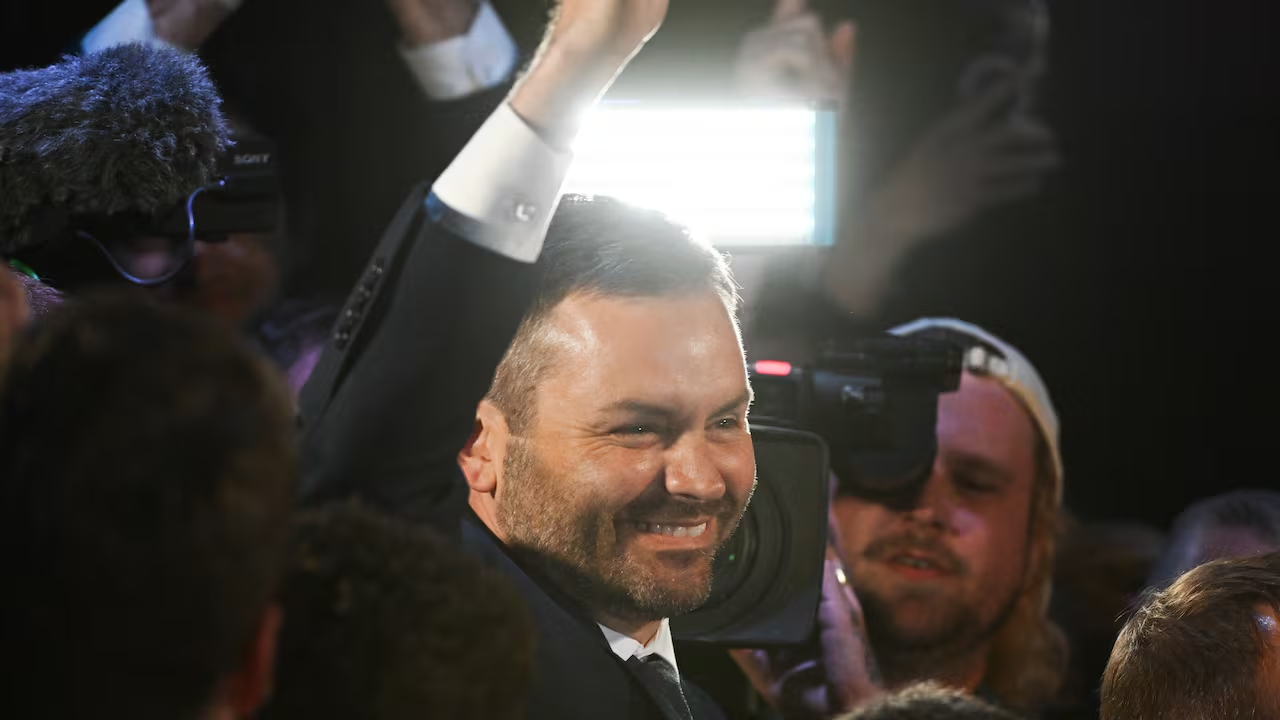
A seat-by-seat breakdown of how Paul St-Pierre Plamondon reached the premier's office, why a referendum is still years away, and which parties now hold leverage in a minority National Assembly.
The Quebec election results delivered on Monday, October 5, 2026 have redrawn the province’s political map more sharply than any single vote in recent memory: the sovereigntist Parti Québécois won enough seats to form a minority government, while the governing Coalition Avenir Québec was projected to lose every one of its seats. Leader Paul St-Pierre Plamondon, who led a three-seat caucus into the campaign, will become Quebec’s next premier at the head of a 59-seat bloc.
The outcome reopens a question Quebec politics had largely parked for a decade — a third referendum on sovereignty — while simultaneously making it far harder to act on. Without a majority, St-Pierre Plamondon will need partners for almost everything he wants to do, including the constitutional file that defines his party.
From Three Seats to 59: The Scale of the PQ’s Turnaround
In 2022, the Parti Québécois was reduced to three seats and was widely written off as a spent electoral force. Four years later it is the governing party. That swing is the single most consequential number in the Quebec election results, and it happened without the party crossing the majority threshold its leader had openly campaigned for.
St-Pierre Plamondon used his victory speech to signal how he intends to govern in that position. He promised to work with other parties and said he would be “direct and transparent” with Prime Minister Mark Carney — language that sets up a relationship with Ottawa likely to be watched closely on both sides of the Ottawa River.
He also made a deliberate switch into English to address what he called his “English-speaking friends in Quebec,” telling them he would be “the premier of everyone in Quebec” and that “we share the same future.” Near the end of the same speech he returned to the party’s founding purpose, telling supporters he still dreams of making Quebec a country and invoking what he described as the “courageous struggle of francophones” to preserve their culture. “We deserve it just as much as any other people who possess their own country and democracy,” he said.
How the Seats Fell on Monday Night
The movement was not confined to one party. Three of the five main blocs changed size dramatically, and one disappeared entirely.
| Party | Seats in 2022 | Seats on Oct. 5, 2026 |
|---|---|---|
| Parti Québécois | 3 | 59 |
| Quebec Liberal Party | 19 | 40 |
| Conservative Party of Quebec | 0 | 19 |
| Québec solidaire | 11 | 9 |
| Coalition Avenir Québec | Majority government | 0 |
Readers following the count through the night can revisit our earlier coverage of how the Parti Québécois minority government was projected as the CAQ was wiped out, and the subsequent confirmation that the PQ won but fell short of a majority.
Why a Sovereignty Referendum Is Not Imminent
A PQ premier does not automatically mean a referendum campaign. In practical terms, the arithmetic of a minority legislature stands in the way. To move a referendum forward, the PQ would need the support of Québec solidaire, the only other sovereigntist party now sitting in the National Assembly.
St-Pierre Plamondon has said he would hold off on a referendum until 2029 or 2030, after U.S. President Donald Trump leaves office. That timeline runs into an awkward reality of Quebec parliamentary history: minority governments in the province typically last less than two years, meaning the government that would stage such a vote may not be the one elected on Monday.
The opposition has already drawn its line. Liberal Leader Charles Milliard said his party would collaborate on many issues, but switched to English to state that “there is no way we will collaborate on a potential referendum.”
General background for readers outside Quebec: the province has held two province-wide referendums on sovereignty, in 1980 and 1995, both of which ended with a No result. No date, question or legislative framework for any further vote has been announced.
The CAQ’s Collapse: Christine Fréchette Takes the Blame
Four years after winning a commanding majority, the Coalition Avenir Québec was erased. The party did not win a single seat. Christine Fréchette, who took over as premier from François Legault, was unable to turn around voter frustration after eight years of CAQ government.
“I have Quebec tattooed on my heart,” Fréchette said in her concession speech, noting that she was the second woman to lead the province. “I gave everything I could.” Speaking at party headquarters in Trois-Rivières, she said the party’s fall was her responsibility alone and called being premier the greatest honour of her life.
The result raises immediate questions about whether the party can survive. The CAQ has little grassroots infrastructure to fall back on and no longer has a single member of the National Assembly. It was co-founded by Legault as an alternative to the long-running Liberal–PQ argument over sovereignty — the very dynamic that now looks set to return to the floor of the legislature.
Charles Milliard’s Liberals Land a Stronger Opposition Than Expected
The Quebec Liberal Party came out of Monday in better shape than most observers had projected, climbing from 19 seats to 40. Milliard framed that result as a mandate for restraint on the government’s part, telling supporters that voters had elected a National Assembly without a majority and that the PQ would therefore be obliged to consider proposals from other parties.
He said the Liberals would review the PQ’s proposals and weigh whether they serve the province’s interest — a posture of conditional cooperation rather than blanket opposition, with the referendum file carved out as the exception.
Éric Duhaime’s Conservative Breakthrough
The Conservative Party of Quebec went from zero seats in 2022 to 19, giving leader Éric Duhaime a seat in the National Assembly for the first time. He campaigned on tax and spending cuts, an agenda that could make his caucus a situational partner for the PQ on shared fiscal priorities.
“Tonight, hope has returned to Quebec,” Duhaime told supporters. “We have just written a page in history.” He also made a direct pitch to English-speaking voters, urging them to look past the Liberals and consider his party as a credible alternative — a notable play for a constituency the Liberals have long treated as a base.
Québec Solidaire’s Nine Seats and the Balance of Power
Québec solidaire dropped from 11 seats to nine, a result the party treated as a survival story rather than a setback. “We resisted,” co-spokesperson Ruba Ghazal told supporters. “Québec solidaire is the energy I see here tonight — the energy of people who fight with all their heart.”
The party campaigned on raising taxes on Quebec’s wealthiest and redirecting that revenue into public education and health care. In a minority legislature, and as the only other sovereigntist party in the chamber, its nine votes carry weight well beyond their number — both on the PQ’s fiscal agenda and on any constitutional move.
A Government Elected With Less Than 30 Per Cent of the Vote
One statistic from the Quebec election results will keep the electoral reform debate alive: for the first time in Quebec history, a party will form government with less than 30 per cent of the popular vote.
During the campaign, St-Pierre Plamondon, the Conservatives and Québec solidaire all pledged to overhaul the province’s voting system. Three of the four parties now seated in the National Assembly are therefore on record in favour of change, and Monday’s distortion between votes and seats gives that pledge fresh urgency. No legislation, timeline or model has been introduced.
What a PQ Premier Means for the Carney Government
The federal dimension of this result is unavoidable. A sovereigntist premier in Quebec City changes the tone of federal–provincial relations even in the absence of a referendum campaign, and St-Pierre Plamondon’s promise of “direct and transparent” dealings with Prime Minister Mark Carney was read in Montreal as a warning as much as an offer.
For business readers, the near-term question is less constitutional than practical: how a minority government with an unpredictable voting arithmetic handles budgets, major projects and the provincial fiscal framework. Markets have so far taken the political news in stride, with the S&P/TSX composite grinding modestly higher through the same stretch.
The next concrete markers to watch are the swearing-in of the new premier and cabinet, the opening of the National Assembly, and the first confidence test — the point at which the Liberals, Conservatives and Québec solidaire each have to decide how long this government lasts. None of those dates has been set.

The Brand Magazine Newsroom covers Canadian business, markets and policy news for brand builders and entrepreneurs. Newsroom reports are produced from published public sources such as company releases and government and regulator publications, and follow our Editorial Standards.