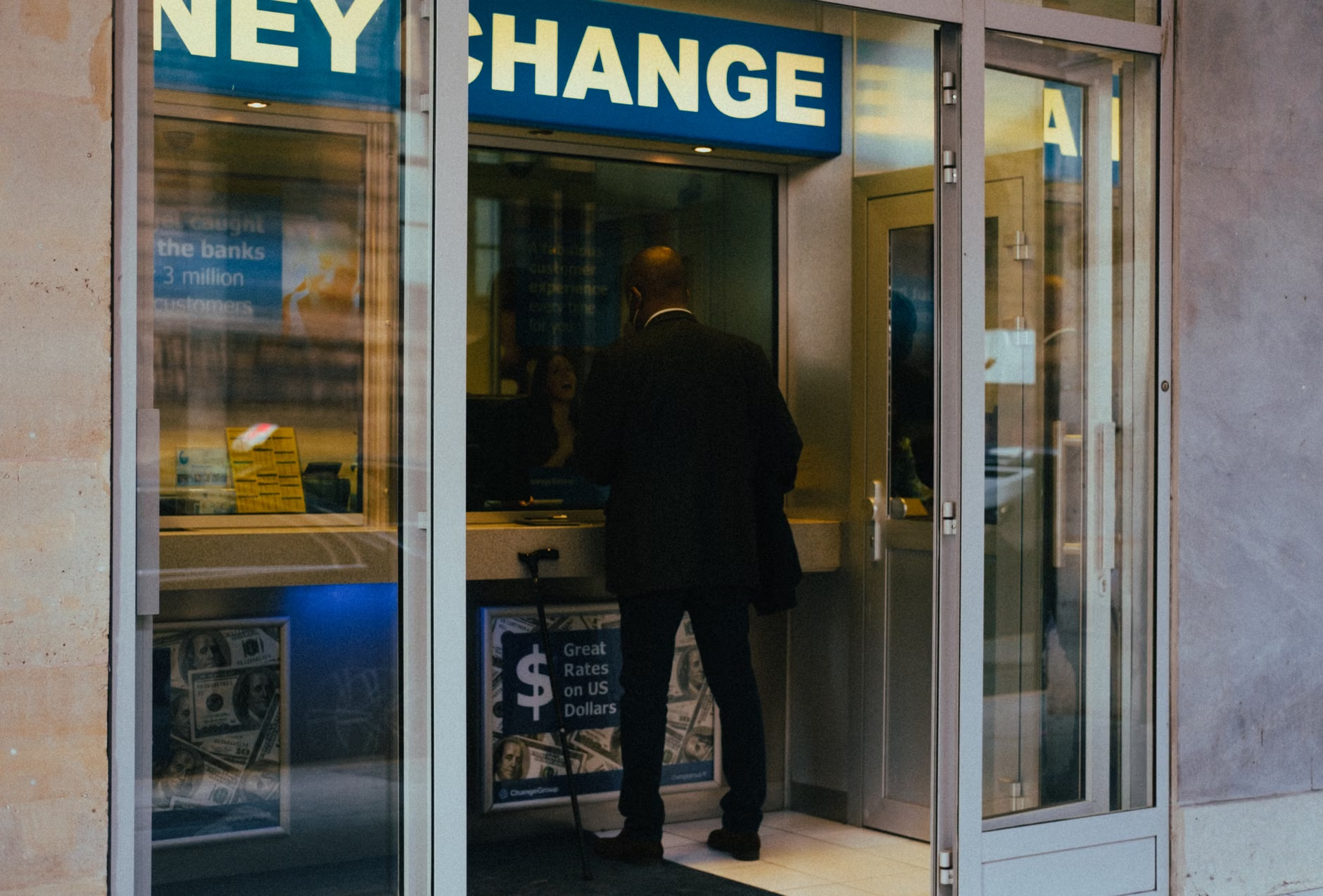
A breakdown of why market pricing swung toward a hike, what the Bank will see before it decides, and how variable-rate holders, renewers and savers are positioned.
Market pricing for a Bank of Canada rate hike at the central bank’s Oct. 28 announcement has swung to something close to a coin flip, a sharp shift from the settled expectations traders were carrying into the fall. The move follows a climb in oil prices and a corresponding rise in bond yields, two forces that feed directly into the inflation outlook the Bank will publish alongside its decision.
The change matters well beyond trading desks. Canadians holding variable-rate mortgages, homeowners facing a renewal in the coming months, and savers sitting in cash or term deposits all take their cues from the same overnight rate. A single decision late in October now carries more genuine suspense than it did a few weeks ago.
Why Oil Prices and Bond Yields Moved the Odds
Two linked developments drove the repricing. First, oil prices pushed higher, which lifts headline inflation almost mechanically through gasoline, transportation and the cost of moving goods. Second, bond yields rose, which is both a symptom of shifting inflation expectations and a driver of the fixed mortgage rates lenders post.
For an oil-producing economy like Canada’s, higher crude is not a one-directional story. It supports national income, provincial revenues and the currency, while simultaneously raising the price level that the central bank is mandated to keep in check. That tension is exactly what makes the October call difficult rather than obvious.
Bond markets, meanwhile, do not wait for the Bank to act. Yields have already moved, and lenders price fixed-term products off that curve, which is why some borrowers may feel the shift before any official announcement is made.
What Capital Economics Expects in the Late-October Outlook
Capital Economics’ chief North America economist said the Bank will “inevitably upgrade its inflation forecasts” in its late-October outlook to account for elevated oil prices. That is a meaningful signal: the Bank’s published projections are the framework it uses to justify where the policy rate needs to sit.
Even so, the same economist’s base case is that the Bank does not hike in October — while describing it as a close call. That distinction is worth holding onto. An upgraded inflation forecast does not automatically translate into an immediate rate increase; the Bank can revise its numbers while holding policy steady and signalling that it is watching closely.
In practical terms, the market and the forecast are not saying the same thing. Traders are pricing meaningful probability of a move. At least one prominent forecaster still expects a hold. Both positions can be defensible when the incoming data is genuinely mixed.
The Data Landing Before the Oct. 28 Decision
Before governing council meets, it will have a fuller picture than the market currently does. The Bank will receive fresh readings on inflation, the labour market and GDP, plus the results of its own consumer and business surveys.

- Inflation: The key question is whether higher energy costs are bleeding into broader price categories or staying contained in the energy line.
- Labour market: Employment and wage trends indicate whether domestic demand is strong enough to sustain price pressure.
- GDP: Growth momentum tells the Bank how much slack, if any, is absorbing the shock.
- The Bank’s own surveys: Its consumer and business survey work captures inflation expectations directly — arguably the most closely watched input when an energy shock is in play.
If those surveys show expectations drifting upward, the argument for acting sooner strengthens considerably. If they show households and firms treating higher oil as temporary, the case for patience holds.
What a Bank of Canada Rate Hike Would Mean for Variable-Rate Borrowers
Variable-rate mortgage holders are the most directly exposed group. Their rate is tied to lender prime, which moves with the central bank’s overnight rate, so a policy increase transmits to them faster than to any other borrower.
How that shows up depends on the product. On an adjustable-rate mortgage, the monthly payment itself rises. On a variable-rate mortgage with a fixed payment, the payment can stay the same while a larger share of it is redirected to interest and less to principal — which extends the effective amortization rather than changing the amount leaving the bank account each month.
Neither outcome is catastrophic on its own, but both change the arithmetic of a household budget that was built around a falling-rate assumption. The specific dollar impact depends entirely on individual balance, term and lender terms, which the source material does not quantify.
Renewals Are the Quieter Pressure Point
The renewal wave is the part of this story that plays out over years rather than a single decision day. Borrowers who locked in during the ultra-low-rate period and are now coming up for renewal face a reset against a very different rate environment, regardless of what happens on Oct. 28.
A hike would make that reset marginally less forgiving; a hold would not undo it. This is consistent with the broader direction we covered in our reporting on how Canada’s mortgage rate forecast now points upward through 2027, and it is why renewal planning has become a live financial-planning question rather than a routine paperwork exercise.
Because fixed rates track bond yields rather than the overnight rate, renewers shopping today are already negotiating against the higher yield environment that helped move the hike odds in the first place.
The Side of the Ledger That Benefits
Higher policy rates are not uniformly bad news. Savers, retirees drawing income from fixed-income products, and anyone holding cash generally see better returns on high-interest savings accounts, guaranteed investment certificates and money-market instruments when the overnight rate rises.

As general market context — not a specific product claim — the pattern across rate cycles has been that deposit and GIC yields firm up after a hike, while they compress during easing cycles. Anyone weighing whether to lock in a term now or wait is effectively making the same bet the bond market is making.
Why the Decision Is Harder Than a Typical Meeting
Central banks usually prefer to look through commodity-price shocks. Energy is volatile, and reacting to every swing risks tightening into a slowdown or easing into a boom. The reason this episode is more awkward is that the oil move is arriving alongside rising yields and a growth backdrop clouded by trade tension.
Ottawa’s own posture has reflected that uncertainty, with the federal government openly weighing economic contingencies — as seen in the discussion around Prime Minister Mark Carney’s remarks on Canada’s planning for U.S.-related risks. A central bank raising rates into that kind of external uncertainty has to be confident the inflation signal is real and persistent.
That is the crux of the close call: the price data may justify tightening, while the growth and confidence data may argue for waiting one more meeting.
What to Watch on Oct. 28
The rate number itself will be the headline, but the accompanying material will tell readers more about the months ahead. Three things are worth tracking:
- The revised inflation projection: How far the Bank lifts its forecast, and whether it frames the oil effect as temporary or persistent.
- The language on future moves: A hold paired with hawkish wording is functionally a warning that a hike is queued up.
- The survey commentary: Any reference to inflation expectations shifting among households and businesses would be the strongest tell.
For borrowers, the practical takeaway is preparation rather than prediction. Knowing your exact product type, your renewal date and how your payment responds to a prime-rate change is useful whether the Bank moves or not.
This article reports market expectations and published forecasts. It is not financial advice, and probabilities priced by traders frequently change before a decision date.
Frequently Asked Questions
When is the Bank of Canada’s next interest rate decision?
The decision is scheduled for Oct. 28, and it will be accompanied by the Bank’s updated economic and inflation outlook.
Does a coin-flip market price mean a hike is confirmed?
No. It means traders are assigning roughly even probability to a hike and a hold. Capital Economics’ chief North America economist still expects no hike in October, while calling it a close call.
Why would rising oil prices push the Bank toward hiking?
Higher crude feeds into fuel, transport and goods costs, lifting headline inflation. The economist quoted said the Bank will inevitably upgrade its inflation forecasts to reflect elevated oil prices.
Would fixed mortgage rates rise only if the Bank hikes?
No. Fixed rates are priced off government bond yields, which have already moved. The overnight rate directly drives variable and adjustable products through lender prime.
How much would my payment increase if there is a hike?
Not specified. The impact depends on your mortgage balance, product type, term and lender, and the source material does not provide dollar figures.

The Brand Magazine Newsroom covers Canadian business, markets and policy news for brand builders and entrepreneurs. Newsroom reports are produced from published public sources such as company releases and government and regulator publications, and follow our Editorial Standards.