A breakdown of the six moving parts in Canada's banking regulator's September slate — and the two items that quietly slipped to later dates.
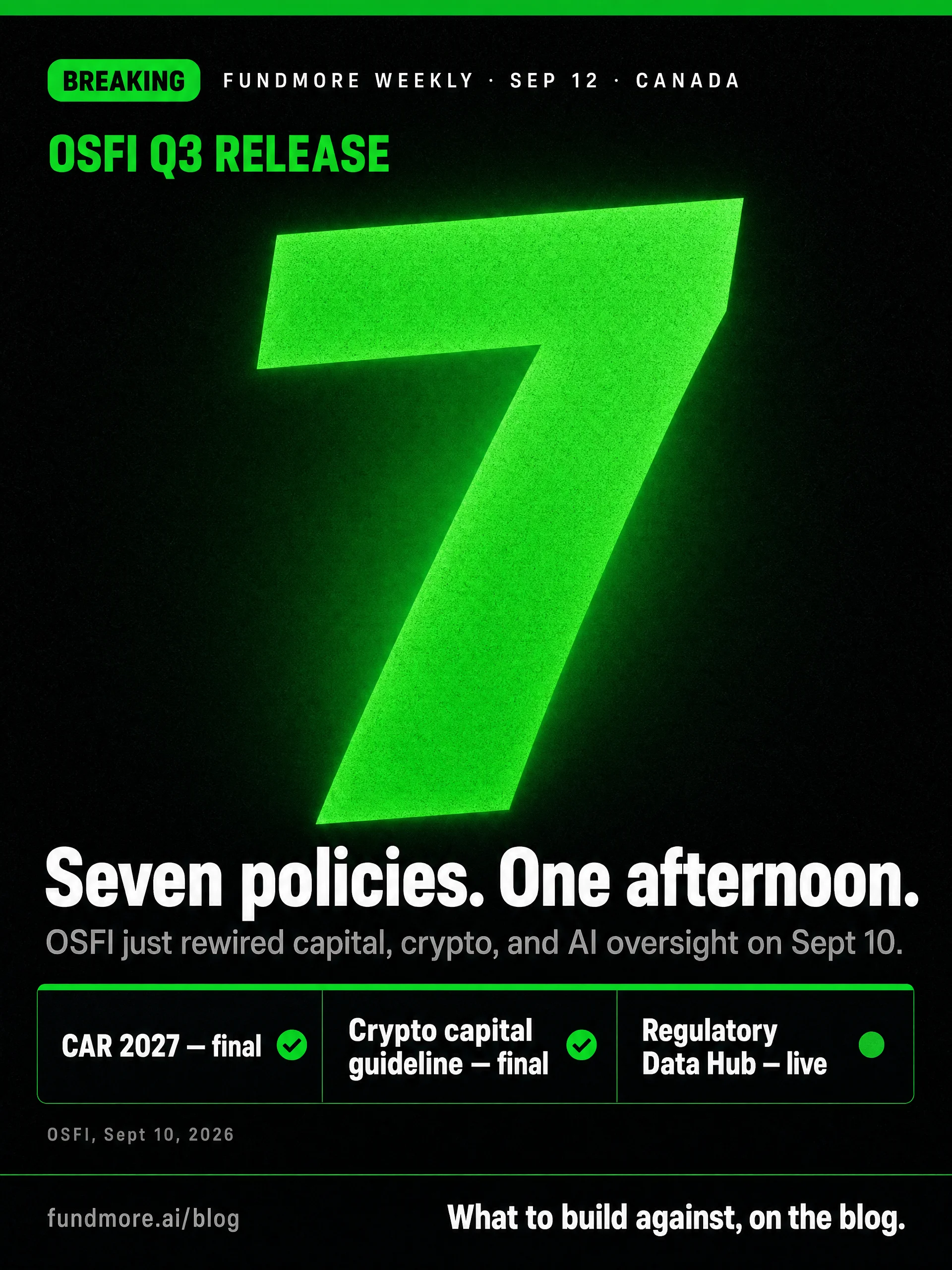
The OSFI Q3 release landed on September 10, 2026, and it was not a single guideline drop. Canada’s banking regulator finalized its 2027 Capital Adequacy Requirements (CAR) Guideline, the capital and liquidity treatment of crypto-asset exposures for banks, and Guideline B-12 on interest rate risk management — while simultaneously advancing model governance, an AI-driven cyber threat briefing and the data platform that will carry every future filing.
What Landed in the September 10 Slate
According to OSFI’s own publication schedule, the third quarterly release contained a mix of final guidelines, revised implementation guidance and one new consultation. The banking items dominated, but the property and casualty insurance side was included as well.
- Final CAR 2027 Guideline: the updated Capital Adequacy Requirements framework for federally regulated deposit-taking institutions.
- Final crypto-asset guideline: Capital and Liquidity Treatment of Crypto-asset Exposures (Banking), effective for 2027.
- Revised Implementation Note: updated guidance on regulatory capital models.
- Final Guideline B-12: interest rate risk management.
- Final MICAT: the Mortgage Insurer Capital Adequacy Test, on the property and casualty side.
- Draft TLAC Guideline: a Total Loss Absorbing Capacity guideline has entered consultation.
The release also carried an update on Data Collection Modernization, the multi-year effort to move regulatory filings onto a new corporate data platform.
Two Items That Slipped: B-6 Liquidity and Pillar 3 IRR Disclosures
Two pieces did not appear as originally scheduled. Draft Guideline B-6, Liquidity Principles, has been pushed to February 2027. The final Pillar 3 Disclosures for Interest Rate Risk moved to the Fourth Quarterly Release on November 19, 2026, and the Credit Risk Management chapters moved with them.
Deferrals of this kind are generally not a loosening signal. In prudential regulation, a slipped date more often indicates that calibration is still being worked through with industry — which means the eventual text can be more demanding, not less, than the draft that was expected.

Why CAR 2027 Matters for SME Lending Capacity
OSFI has been consistent in its public framing of the CAR revisions: the aim is to better align capital treatment with underlying risk and to support increased lending to smaller corporates. The 2027 iteration continues work that the regulator’s CAR backgrounder set out the previous year.
For institutions with a meaningful small and medium-sized enterprise book, that is a structural tailwind — capital freed at the margin can be redeployed into commercial growth. For lenders without an SME franchise, it turns into a strategic question about whether to build one. Credit committees still calibrating to the outgoing treatment risk conceding share to competitors that recalibrate first.
A Crypto Capital Rulebook While U.S. Peers Are Still Improvising
The finalized crypto-asset guideline gives federally regulated Canadian banks a supervisor-endorsed framework for capital and liquidity treatment of crypto exposures, covering trading, custody-adjacent and balance-sheet positions, with defined exposure categories and corresponding capital charges.
The competitive read is straightforward. Where some U.S. institutions are piloting on public chains and pursuing trust charters without settled prudential treatment, Canadian banks now have a published rulebook to design against. The practical difference is between building a product to a known standard and negotiating one case by case. It follows the same direction of travel as the regulator’s earlier position that tokenized deposits remain deposits for regulatory purposes, and it arrives while the country’s largest lenders are working on a shared digital deposits network.

The Regulatory Data Hub Is the Quiet Structural Change
The item easiest to overlook is the infrastructure one. OSFI’s Data Collection Modernization initiative begins onboarding federally regulated banks and insurers to a new corporate data platform this quarter, with filings migrating into the Regulatory Data Hub.
The consequence compounds over time. For institutions that own clean, sourced data, the marginal cost of responding to each future supervisory request falls. For institutions that assemble filings through copy-and-transform workarounds, the cost of every new ask rises. Reporting burden becomes a function of data architecture rather than headcount.
The AI Threat Briefing Sits in Operational Resilience, Not Model Risk
Included in the Industry Day agenda was an AI Accelerated Threat Landscape briefing developed with the Canadian Centre for Cyber Security, focused on frontier AI threats and recommended mitigations.
The framing is notable. OSFI is not debating whether generative AI raises fraud and cyber tail risk; it is placing the issue on the table and pointing to concrete controls. Boards that have treated artificial intelligence purely as a model-governance topic now have a supervisor-endorsed operational-resilience angle to plan against — one that pulls in treasury, cyber, fraud and vendor management alongside model risk teams. The expectation, as presented, is that this framing informs future guidance rather than arriving as a discrete new rule.

What Lenders Are Being Advised to Do This Quarter
The practical checklist emerging from the release is short but cuts across several functions.
- Read the crypto guideline against the roadmap, not the book: the question is what can now be built to a known standard, not only what is already on the balance sheet.
- Map SME capacity into CAR 2027: recalibrate credit committee assumptions rather than running the old treatment into the new year.
- Onboard to the Regulatory Data Hub with a clean-data posture: patched filings accumulate technical debt with every cycle.
- Move AI risk into operational resilience: give cyber, fraud, treasury and vendor management formal seats at the table.
- Diarize November 19: Pillar 3 interest rate risk disclosures and large exposures land there, alongside the Credit Risk Management “What We Heard” report.
Interest Rate Risk Guidance Meets a Shifting Rate Backdrop
Final Guideline B-12 arrives at a point when Canadian lenders are already managing balance sheets through an uncertain rate path. Interest rate risk frameworks, Pillar 3 disclosure requirements and liquidity principles are all moving within roughly a six-month window, which makes sequencing a genuine planning problem for treasury teams.
Readers tracking the monetary policy side of that equation can follow the central bank’s own reasoning in the Bank of Canada’s September summary of deliberations, which sets the macro context prudential rules are being written into.
The Through-Line: Build on What Exists
One consistent thread runs across the slate. OSFI is layering onto existing infrastructure rather than asking institutions to rip and replace. Capital rules update an established framework, crypto treatment extends familiar exposure logic, and the data platform consolidates filings that were already being produced.

That favours lenders able to plug into new requirements without launching multi-year technology programs. Institutions with a clean, sourced digital representation of their balance sheet will file faster and defend positions more easily under supervisory review; those without one will spend the 2027 cycle reconciling rather than deciding.
With the Fourth Quarterly Release set for November 19, 2026 and draft Guideline B-6 now expected in February 2027, the sequence of changes described here runs well into next year. Implementation timing for each guideline is set out in the guidelines themselves and their companion implementation notes, and institutions should confirm specifics with their supervisory contacts rather than relying on summaries.
Frequently Asked Questions
When was CAR 2027 finalized, and when does it take effect?
OSFI finalized the guideline on September 10, 2026. Implementation timing is set out in the guideline and its companion implementation note, and institutions are directed to confirm details with their supervisory team.
What exactly is the Regulatory Data Hub?
It is OSFI’s new corporate-data filing platform. Release 1 begins onboarding federally regulated banks and insurers this quarter as part of the Data Collection Modernization initiative.

Does the crypto capital guideline cover custody, trading or issuance?
It addresses capital and liquidity treatment for crypto-asset exposures held by federally regulated banks, including trading, custody-adjacent and balance-sheet exposures, with defined exposure categories and calibrated capital charges.
Which items were moved out of the third quarterly release?
Draft Guideline B-6, Liquidity Principles, moved to February 2027, and the final Pillar 3 Disclosures for Interest Rate Risk moved to November 19, 2026, per OSFI’s policy plan letter. The Credit Risk Management chapters shifted with them.
Is the AI threat briefing a new rule?
No. It was presented as part of operational resilience, with mitigations drawn from Canadian Centre for Cyber Security resources, and is expected to inform future guidance rather than stand as a separate requirement.
This article reports on regulatory developments and is not financial, legal or compliance advice. Institutions should verify all timing and applicability directly with the published guidelines and their supervisory contacts.

The Brand Magazine Newsroom covers Canadian business, markets and policy news for brand builders and entrepreneurs. Newsroom reports are produced from published public sources such as company releases and government and regulator publications, and follow our Editorial Standards.