Market pricing has flipped from cuts to hikes — here is what the forward curve, the Big Six split and a 125-basis-point prime climb mean for renewals and first mortgages.
The latest Canada mortgage rate forecast has quietly reversed the story Canadian borrowers have been told for two years: the era of falling rates is over, and market pricing now leans toward increases. An updated outlook published on September 25, 2026 and built on the forward CORRA (Canadian Overnight Repo Rate Average) curve as of September 23 shows the Bank of Canada’s 2.25% policy rate climbing to roughly 3.50% by the end of 2027, dragging prime and variable mortgage costs with it.
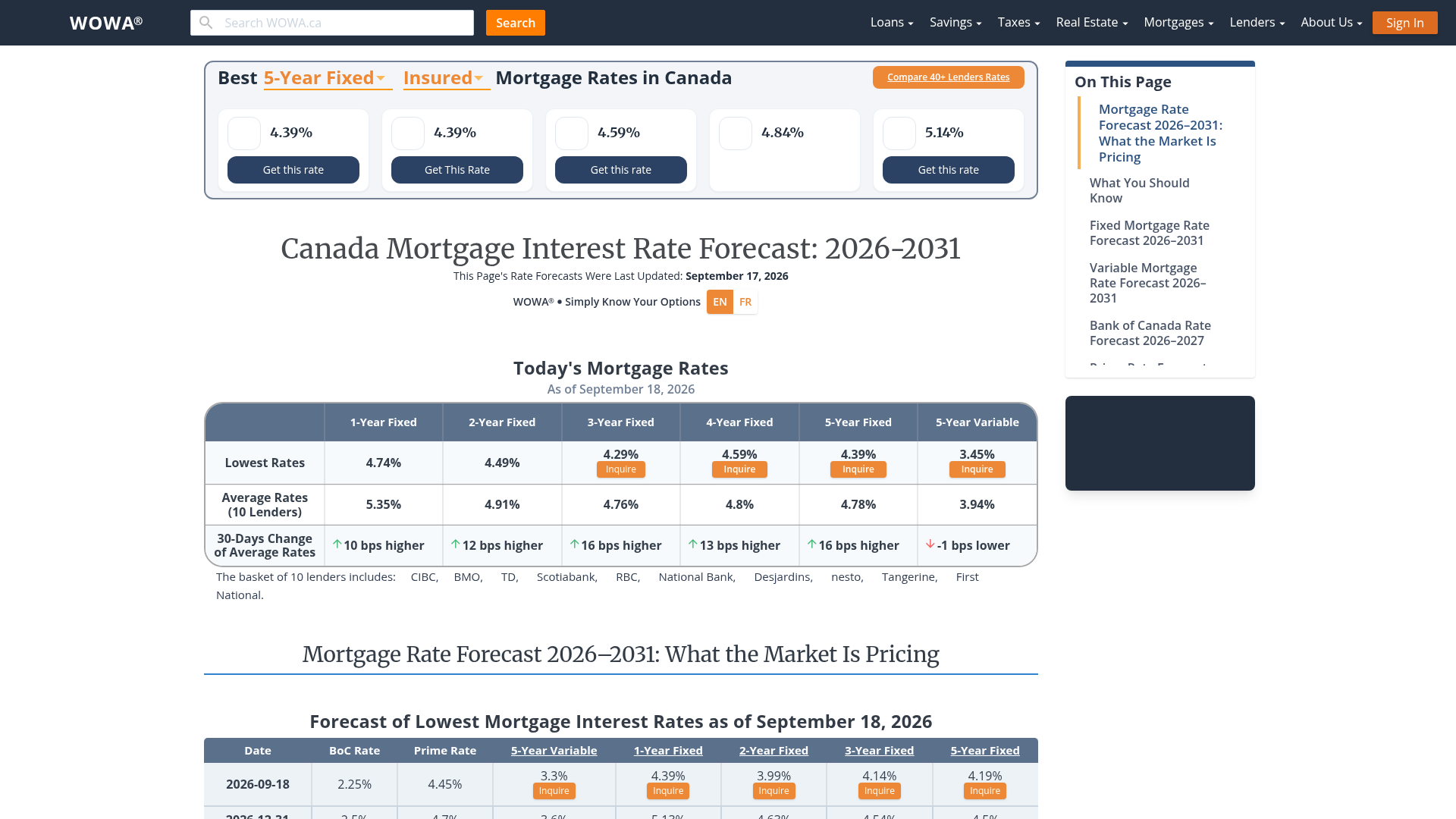
The prime rate currently sits at 4.45% and moves in lockstep with the central bank. If the forward curve is right, prime reaches about 5.45% by mid-2027 and roughly 5.70% by year-end — an increase of about 125 basis points that variable-rate and HELOC holders would feel almost immediately in their payments.
How a Strait of Hormuz Energy Shock Boxed In the Bank of Canada
The policy shift traces back to geopolitics rather than domestic overheating. The Bank of Canada had cut its way down to 2.25% by November 2025, balancing support for an economy bruised by U.S. tariffs against manageable price growth at home. That easing path stalled in early 2026.
The U.S.–Israel war with Iran, which began in late February 2026, disrupted the Strait of Hormuz — a chokepoint carrying roughly a fifth of global oil supply. An April ceasefire and a June deal to reopen the Strait both collapsed. By August 2026, Hormuz traffic had fallen sharply and Brent crude sat near US$90, about 24% above pre-war levels.
The inflation math followed. Headline CPI reached 3.0% in August 2026 with gasoline up 29% year over year, while core measures stayed close to target — CPI-trim at 1.9% and CPI-median at 2%. That split is the entire policy story: the spike is energy-driven, not broad-based, which is why the Bank held at 2.25% on July 15 for a sixth consecutive meeting rather than tightening outright.
What the Forward CORRA Curve Prices for Rates Through 2031
Forward contracts are not predictions so much as the price the market is willing to pay today for future borrowing costs. As of late September 2026, that pricing implies a slow, stepped climb rather than a shock.
| Date | BoC rate | Prime | 5-yr variable | 5-yr fixed |
|---|---|---|---|---|
| Sept 25, 2026 | 2.25% | 4.45% | 3.25% | 4.29% |
| Dec 31, 2026 | 2.50% | 4.70% | 3.60% | 4.40% |
| June 30, 2027 | 3.25% | 5.45% | 4.35% | 4.47% |
| Dec 31, 2027 | 3.50% | 5.70% | 4.60% | 4.50% |
| Dec 31, 2028 | 3.50% | 5.70% | 4.60% | 4.54% |
| Dec 31, 2031 | 3.50% | 5.70% | 4.60% | 4.82% |
On a meeting-by-meeting basis, the pricing gives the October 28, 2026 announcement a 62% probability of a hold and a 38% chance of a 25-basis-point increase. The December 9 meeting carries a 90% probability of a hike. From there the curve steps up through 2027 before flattening at 3.50% for the remainder of the forecast window.
These figures assume risk and term premiums stay constant and that the market’s read on the risk-free rate is correct. They are re-priced weekly, so the direction matters more than any single decimal.
TD and BMO Say Hold, RBC and Scotiabank Say Higher
Canada’s largest lenders are more divided than the futures market, but they agree on one thing: nobody meaningful is forecasting further cuts.

- TD Economics (September 2026): policy rate stays at 2.25% straight through the end of 2027.
- BMO: also sees a hold at 2.25% through 2027.
- RBC Economics (August 2026): 2.25% through end-2026, rising to 3.25% by the end of 2027.
- Scotiabank Economics (September 2026): 2.50% by the end of 2026 and 3.00% by the end of 2027.
- CIBC and National Bank: 2.75% during 2027.
The spread between the most dovish and most hawkish Big Six call is a full percentage point by the end of 2027 — a wide band that reflects genuine uncertainty about whether energy inflation bleeds into core. For households, the practical reading is that the risk is skewed upward: plan around a central bank that holds and then raises, not one that resumes cutting.
Why Fixed Mortgage Rates Move Before the Central Bank Does
One of the most persistent misunderstandings in Canadian household finance is that the Bank of Canada sets mortgage rates. It sets prime, which drives variable rates and lines of credit. Fixed mortgage rates are priced off Government of Canada bond yields, which is why they often move weeks or months ahead of a policy decision.
The lowest available five-year fixed rate currently sits near 4.22% and is projected to reach roughly 4.50% by the end of 2027 and about 4.71% by the end of 2030 — drift, not a jump. The three-year fixed, also around 4.22%, is the term the market is pricing most attractively, staying in the low-to-mid 4% range through 2028.
Shorter terms are not automatically cheaper. The lowest one-year fixed sits near 4.54%, above several longer terms, largely because a lender recovers fixed origination and servicing costs over fewer years and needs a wider annual margin to do it.

The Vanishing Variable Discount
The lowest five-year variable rate is near 3.35% today, a meaningful discount to fixed. The forecast has it climbing to about 3.60% by the end of 2026, 4.35% by mid-2027 and roughly 4.60% by 2028, where it plateaus alongside the policy rate.
In other words, the market expects variable rates to catch up to today’s fixed rates by 2027, erasing most of the advantage variable holders currently enjoy. A variable rate only wins if rates rise by less than the current discount to fixed. That is a bet, not a default setting — and it is the same kind of risk calculus Canadians have been weighing across other asset classes, as we explored in our look at whether crypto is becoming the new cash.
What Renewals in 2026 and 2027 Actually Look Like
Roughly speaking, renewing borrowers fall into two camps. Those rolling off pandemic-era fixed rates below 2% will still face payment shock at today’s roughly 4.22%, even though rates have eased considerably from the 2023 peak. Those renewing off 2023–2024 peak rates of 5.5% or higher should see some relief.
Because the curve drifts up rather than down, waiting for a better number is a weak strategy. Most lenders allow a renewal rate hold 120 to 150 days ahead, which protects the downside at no cost — and if rates do fall, most lenders still honour the lower rate at closing. Comparing lenders at renewal, rather than signing the first offer that arrives in the mail, remains the single highest-return hour of work available to a Canadian homeowner.

Homebuyers, the Stress Test and a $670K Average Price
With the average Canadian home near $670,000 and the lowest advertised rates running roughly 3.3% to 4.0%, a buyer with 20% down carries about a $536,000 mortgage — close to $2,800 a month on a 25-year amortization, of which roughly $1,750 is interest at 4.0%.
Buyers are still qualified at the stress-test rate, the greater of their contract rate plus two percentage points or 5.25%, so the gap between fixed and variable pricing directly affects how much home a household can be approved for. Budgeting against today’s rates and the qualifying rate is the conservative route; budgeting against a hoped-for cut is not. Housing demand also shapes the broader construction and supplier economy, a dynamic visible in the story of how a Canadian glass manufacturer built beyond a single product line.
Tariffs, the CUSMA Review and the Commodity Cushion
Trade policy is the second force pinning the Bank of Canada in place. Through 2025, U.S. measures escalated from a 25% tariff on most non-energy goods and 10% on energy and critical minerals in March, to global steel and aluminum tariffs, a 25% auto tariff, non-exempt IEEPA tariffs at 35% by August, and a further 10% increase in late October. Canada retaliated with 25% tariffs on C$30 billion of U.S. goods.
Tariffs pull in two directions at once: they raise input costs while simultaneously dampening exports, investment and hiring. Offsetting that drag, a global rally in precious metals and crude — the latter driven by the Hormuz shock — is cushioning Canada’s nominal GDP. Real growth is nonetheless stuck near 1.5% to 1.9% through 2027, and the mandatory six-year CUSMA review beginning in July 2026 is expected to be contentious around auto rules of origin and EV supply chains, adding a risk premium to long-term bond yields.

The Three Triggers That Would Rewrite This Forecast
The next scheduled Bank of Canada announcement is October 28, 2026. Beyond that date, three indicators would move the outlook materially:
- Core versus headline CPI: if inflation excluding food and energy stays anchored near 2.0%, the Bank can keep looking through the oil spike; if prolonged shipping disruption pushes core higher, hikes become far more likely.
- Crude benchmarks: a move toward the US$120-per-barrel threshold would put immediate upward pressure on bond yields and therefore on fixed mortgage rates.
- Government of Canada bond yields: the cleanest real-time read on where fixed rates are heading and what markets expect from inflation.
The one credible path back to cuts requires a specific combination: the Strait reopening and oil prices moderating, paired with clear evidence that the U.S. trade war is pushing Canada toward recession. That would free the Bank to ease — but it is not an economy any household would choose to plan around.
Figures cited are market-implied forecasts drawn from forward pricing and published bank outlooks as of late September 2026. They change frequently and are not financial advice; borrowers should confirm current rates and terms with a licensed mortgage professional before making a decision.
Frequently Asked Questions
Does a Bank of Canada hike immediately change my fixed mortgage payment?
No. Fixed rates are priced off Government of Canada bond yields, and an existing fixed mortgage is locked for its term. A policy change affects you at renewal, or sooner if you hold a variable-rate mortgage or HELOC.
How much would a 125-basis-point rise in prime cost a variable borrower?
Every 0.25% increase in prime raises the interest portion of a payment immediately, or extends amortization, depending on the lender’s structure. The forecast implies roughly 1.25 percentage points of increases between now and 2028, with the exact dollar impact depending on balance and contract type.
Why is the one-year fixed rate higher than the three-year?
Lenders recover fixed origination and servicing costs over the length of the term. A shorter term spreads those costs over fewer years, which requires a larger annual margin — pushing the lowest one-year fixed near 4.54%, above several longer terms.
What rate am I actually qualified at when buying?
The stress test requires qualification at the greater of your contract rate plus two percentage points or 5.25%, whichever is higher, which is why the fixed-versus-variable gap affects maximum purchase price.
When is the next Bank of Canada decision?
October 28, 2026, where forward pricing currently gives a 62% probability of a hold at 2.25% and a 38% chance of a 25-basis-point increase.

The Brand Magazine Newsroom covers Canadian business, markets and policy news for brand builders and entrepreneurs. Newsroom reports are produced from published public sources such as company releases and government and regulator publications, and follow our Editorial Standards.