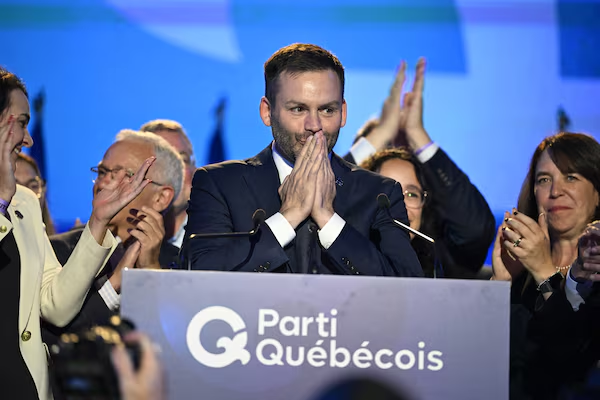
Quebec's separatists are back in office with the weakest mandate in the province's history, and the opposition parties that hold the balance of power have their own views on an independence vote.
Quebec voters have handed power to a Parti Québécois minority government, returning the separatist party to office in the October 5, 2026 provincial election but leaving its central promise, a referendum on independence, in the hands of the other parties in a fractured National Assembly. Incoming premier Paul St-Pierre Plamondon’s party was elected or leading in 59 of 127 seats as of early Tuesday, five short of the 64 required for a majority.
The result caps a five-way contest that exposed a deeply divided electorate. It also wiped out the governing Coalition Avenir Québec after eight years in power and sets up what could be a prolonged fight over whether Quebeckers will be asked about their future in Canada again.
59 Seats and Under 30 Per Cent: A Thin Mandate for the PQ
With 97 per cent of polls reporting, the PQ was on course to win less than 30 per cent of the popular vote. That would be the smallest share of support ever recorded for a governing party in Quebec.
What denied Mr. St-Pierre Plamondon a majority was a late-campaign rise for two federalist-leaning parties: the Quebec Liberal Party and the Quebec Conservatives. Both reject a separation vote and have pledged to block one in the legislature.
The projected standings, based on figures reported early Tuesday, look like this:
| Party | Leader | Projected seats | Position on a referendum |
|---|---|---|---|
| Parti Québécois | Paul St-Pierre Plamondon | 59 | Promises one after 2029 |
| Quebec Liberal Party | Charles Milliard | 40 | Opposed; vows to block |
| Quebec Conservative Party | Éric Duhaime | 19 | Opposed; vows to block |
| Québec solidaire | Ruba Ghazal (co-leader) | Not specified (projected fourth) | Pro-independence; support for PQ timing uncertain |
| Coalition Avenir Québec | Christine Fréchette | 0 | Favours a “third way” without independence |
The thin popular vote is likely to shape the next several years. The new government may have trouble defending the legitimacy of an independence vote won on such limited backing, and pressure to reform Quebec’s electoral system is expected to intensify. For a closer look at that debate, see our earlier coverage of how the PQ took power on under 30 per cent of the vote.
Who Can Help the Parti Québécois Minority Government Trigger a Referendum
Without a majority, the PQ needs support from other parties or individual members of the National Assembly both to stay in office and to call a referendum. In his victory speech, Mr. St-Pierre Plamondon suggested that opposition members who favour independence could provide the votes to make his pledge possible.
The obvious candidate is Québec solidaire, the left-wing separatist party that puts more weight on social justice than on sovereignty. Projected to finish fourth, it held on to many of its Montreal strongholds and could now hold the balance of power.
Whether QS would back the PQ’s referendum plans is an open question. The two parties disagree sharply on immigration and identity, and QS co-leader Ruba Ghazal has called for a broader consultation on what an independent Quebec should look like. On election night, she said her party wants to build an independent Quebec together with immigrants, Indigenous people and anglophones, describing the goal as a country that leaves no one behind.
The arithmetic matters. The Liberals and Conservatives together are projected to hold 59 seats, matching the PQ’s total, and both have said they will not help an independence vote move forward.
St-Pierre Plamondon’s 2029 Timeline and His Message to the Rest of Canada
The PQ Leader has committed to holding a vote on Quebec’s place in Canada once U.S. President Donald Trump leaves office in 2029. At that point, he has said, Quebeckers could have a “serene” discussion about their future.
Although he said little about independence during the campaign, Mr. St-Pierre Plamondon made sovereignty the centrepiece of his victory speech in Montreal. He described a future Quebec that would be French-speaking, prosperous, modern and among the world’s most exemplary democracies, and argued that Quebeckers should not let fear keep them from pursuing their own country.
He also spoke directly to Canadians outside Quebec, saying the independence project is not aimed against them and that Quebec would remain a good-faith partner open to collaboration. For more on what the win means for sovereignty politics, read our report on how the PQ victory puts a third referendum back on the table.
Public Support for Independence Sits Near Historic Lows
The PQ’s ambitions face a steep climb in public opinion. Polls show roughly 30 per cent of Quebeckers support independence, a historically low figure in the province.
- 1980 referendum: 40 per cent voted in favour under a PQ government.
- 1995 referendum: 49 per cent voted in favour, again under the PQ.
- Today: about 30 per cent support independence, according to polls.
The party’s return to power is still a striking comeback. The PQ last governed in 2014 and was reduced to just three seats in 2022.
A Delicate Moment for National Unity and Ottawa’s Relationship With Quebec
The result lands at a sensitive time for the country. A referendum in Alberta is two weeks away, and Canada continues to face pressure on its economy and sovereignty from President Trump.
Quebec has been the province hit hardest by Mr. Trump’s protectionist trade measures, which have targeted its aluminum and forest products industries in particular.
Relations with Ottawa could become considerably more strained. Mr. St-Pierre Plamondon has vowed to abolish Quebec’s lieutenant-governor position and to resist any increase in immigration, just as Prime Minister Mark Carney is trying to keep peace among the provinces in response to U.S. economic pressure.
Mr. Carney congratulated the incoming premier on social media Monday night. He said he looked forward to working together to support Quebec businesses and workers affected by tariffs, create more good jobs, work toward ending homelessness and get more homes built across the province.
How the CAQ’s “Third Way” Collapsed to Zero Seats
The Coalition Avenir Québec, which won back-to-back majorities under former premier François Legault, was shut out entirely. Leader Christine Fréchette lost her own riding.
The CAQ’s brand of nationalism without independence, pitched as a middle path between federalism and separatism, once had broad appeal. But a series of financial mismanagement episodes in recent years damaged the party, and under Ms. Fréchette it could not overcome a powerful desire for change.
An early polling lift tied to the U.S. trade war briefly allowed the outgoing premier to present herself as a defender of Quebeckers. As the initial shock of the conflict faded, voters turned their attention to other concerns. At the party’s election night event at the Delta Hotel in Trois-Rivières, supporters watched the results with little to celebrate.
In her concession speech, Ms. Fréchette took full responsibility for the outcome and said she respected voters’ desire for change. She said the party would keep promoting its third way, built on affirming Quebec’s identity, protecting its language and culture, maintaining autonomy and strengthening its economy. She has pledged to remain leader and to help ease the transition to the new government. Our full rundown of the results covers the CAQ’s collapse in more detail.
Milliard’s Liberals and Duhaime’s Conservatives Split the Federalist Vote
The Quebec Liberal Party, led by newcomer Charles Milliard, was set to finish second with a projected 40 seats. It struggled during the campaign to stand apart from other anti-referendum parties, despite a strong finish.
The province’s most firmly federalist party now faces the prospect of a decade or more out of power, its longest stretch in opposition since the 1950s. Even so, the seat count beat the expectations of many Liberal supporters, and the mood at Mr. Milliard’s gathering in Magog was upbeat.
The incoming Opposition leader drew a clear line. He said a minority means the PQ does not have a blank cheque, and that the Liberals would co-operate on the housing and homelessness crises but not on sovereignty.
The anti-referendum vote was further divided by the provincial Conservative Party, which has no connection to its federal namesake. Under former radio host Éric Duhaime, it was projected to win 19 seats and enter the National Assembly for the first time. The party drew support in the traditionally right-leaning Quebec City and Beauce regions from voters who see government spending as bloated and wasteful.
Cost of Living, Public Services and the French Language Drove the Campaign
Geopolitics largely took a back seat during the campaign. Voters focused instead on worsening public services and the rising cost of living.
- Smaller government: Most parties proposed reducing the size of the public service.
- Lower immigration: A majority of parties also called for cuts to immigration.
- A rightward shift: A small-c conservative mood took hold, with even the historically social-democratic PQ moving to the right.
Despite a rise in pro-Canadian sentiment in recent years, many Quebeckers remain worried about the health of the French language and Quebec culture. Those concerns have been fuelled by years of sharply higher immigration under former prime minister Justin Trudeau and the growth of a largely English-language digital world.
Frequently Asked Questions
How many seats does the PQ have?
The PQ was elected or leading in 59 of 127 seats as of early Tuesday, short of the 64 needed for a majority.
When does the PQ want to hold a referendum?
Mr. St-Pierre Plamondon has said he wants a vote after President Trump leaves office in 2029.
Can the PQ call a referendum on its own?
No. As a minority, it would need backing from other parties or individual members of the National Assembly.
Which parties have said they will block a referendum?
The Quebec Liberal Party and the Quebec Conservative Party have both vowed to block one in the legislature.

The Brand Magazine Newsroom covers Canadian business, markets and policy news for brand builders and entrepreneurs. Newsroom reports are produced from published public sources such as company releases and government and regulator publications, and follow our Editorial Standards.