


Inside the Strasbourg speech, Brussels' offer, Washington's tariff threat, and the treaty problem that still has to be solved before any alliance exists.
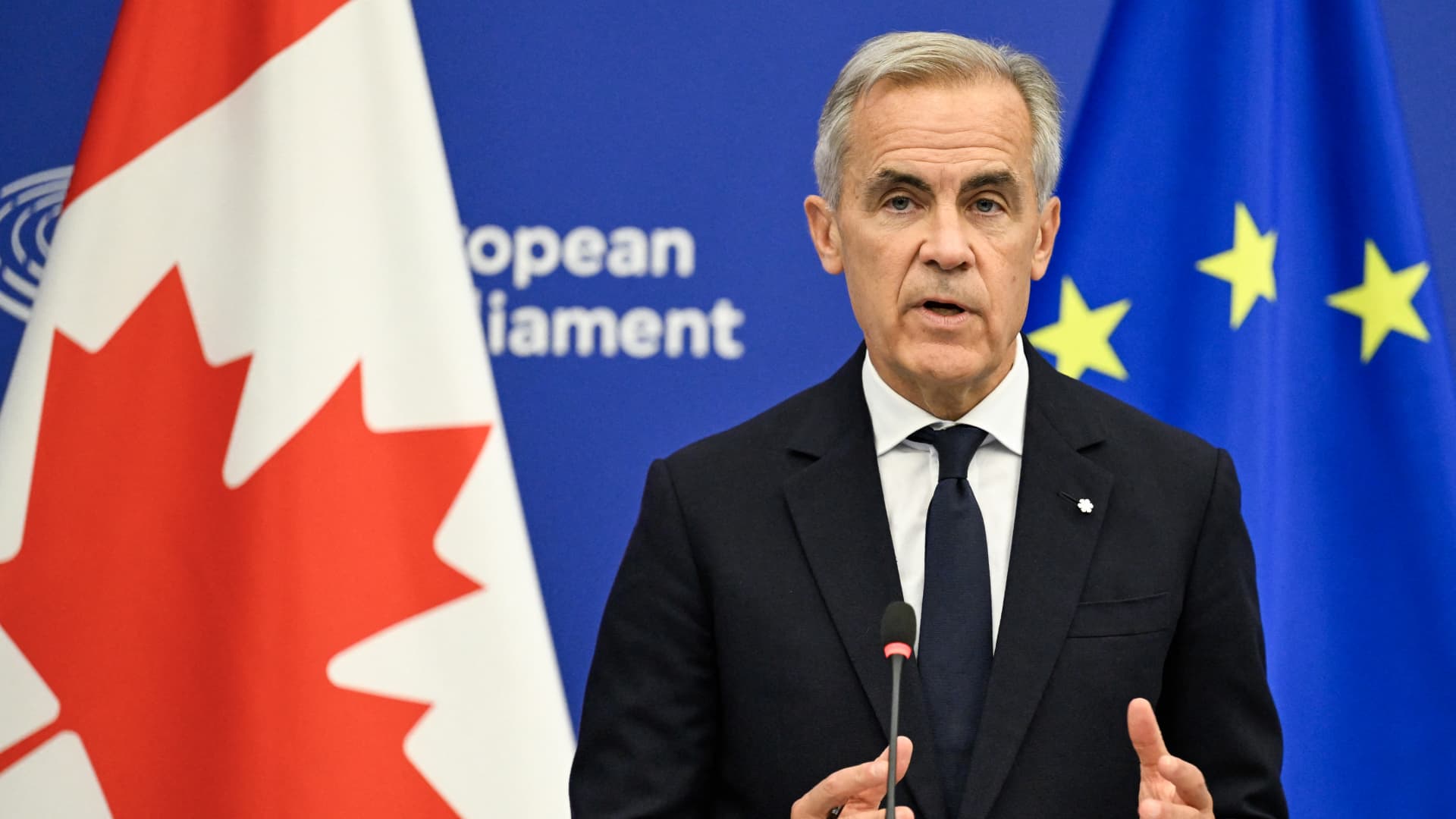
Prime Minister Mark Carney has welcomed the European Union’s proposal to make Ottawa the bloc’s first Canada EU associate member, telling lawmakers in Strasbourg on Thursday, September 17, 2026, that the two partners are “stronger together” and that Canadians would ultimately get a parliamentary vote on whatever structure emerges.
The speech, delivered in the hemicycle of the European Parliament in eastern France, came a day after European Commission President Ursula von der Leyen used her state of the union address to signal she wanted to “open the door” to associate membership for Canada. It also came within hours of U.S. President Donald Trump dismissing the idea as “laughable” and warning of “very heavy tariffs” on Europe if he judged the move a hostile act.
Von der Leyen’s Offer: Taking the Relationship “to the Highest Level Possible”
Von der Leyen made the proposal on Wednesday with Carney in the chamber for her state of the union speech. She said the 27-nation bloc wanted to bring its relationship with Canada “to the highest level possible” and, addressing the prime minister directly, said she would like to work with him “on opening the door for Canada to being the first associate member of the European Union.”
She framed the goal as an upgrade rather than a replacement of existing arrangements: “We will move from CETA to an alliance for the future, to create a common prosperity and economic security space.” She added that the EU and Canada “see the world with the same eyes,” and named artificial intelligence, climate change, geopolitics and Arctic security as shared files.
“Economic Integration Is Now Being Weaponized”: Carney’s Message to MEPs
Carney did not name Trump in his address, but he left little doubt about what he was describing. “Economic integration is now being weaponized — tariffs being used to exert pressure,” he told MEPs.
Switching to French, he continued: “Financial mechanisms have been used for coercion. Supply chains constitute weak points to be exploited.” The framing positions closer transatlantic ties with Europe as a resilience measure rather than a retaliation measure — a distinction Carney returned to repeatedly during the day.

The backdrop is a hardening trade dispute. The Trump administration recently raised tariffs on Canadian goods, Canada answered with levies of its own, and Carney has committed to matching U.S. duties dollar for dollar. For business readers, that reciprocal posture is the immediate cost driver, while the European track is the longer-term hedge — a dynamic that also runs through the investment commitments announced at the recent Canada Investment Summit.
Trump Calls the Plan “Laughable” and Threatens the Bloc
Speaking to reporters in North Carolina before Carney’s address, Trump called Canada a “terrible trade partner” and said the United States could “stop trading with Europe on many things” if Brussels proceeds. He drew a line between motives: “If it’s a good intention, that’s fine. If it’s a bad intention, we’ll put very heavy tariffs on Europe.”
Carney answered at a news conference shortly after leaving the chamber. “This alliance is a positive process; that’s my response to the American president,” he said. “A stronger, more resilient, more sovereign Canada will be a more effective partner with the United States.”
He then made the sovereignty argument explicit: “Canadians are united that nobody is going to tell us what language we speak, no one is going to dictate our culture or with whom we can strike agreements internationally.”
“Not a Third Bloc”: The Limits Carney Set on the Alliance
One of the more carefully constructed passages of the speech was about what Canada is not seeking. Carney said a closer EU relationship would strengthen collective resilience and “create a beacon” for other democracies, but rejected the idea of building a rival power centre.

“Now, I also want to be precise about what I am not proposing, I’m not proposing a third bloc in order to become a great power rival, only with better manners,” he said. “We do not seek power to dominate others. On the contrary, we are pursuing resilience so no one, no one can control our open markets, impair our sovereignty, threaten our territorial integrity, or undermine our freedoms, our democracies, our rule of law.”
Readers following the substance of the proposal itself may want our earlier explainer on what associate membership would and would not give Canada.
The Treaty Problem: Associate Membership Does Not Currently Exist
The central practical obstacle is that there is no such thing as an associate member of the European Union. The category does not exist as a formal status under EU treaties, which means any arrangement of the kind von der Leyen floated would first have to be created and then ratified by member states.
That is not a routine administrative step. The EU has previously been reluctant to open the door to flexible membership tiers — most recently earlier this year, when German Chancellor Friedrich Merz pushed for the bloc to consider associate membership for Ukraine and found limited appetite for it.
Von der Leyen’s public backing for Canada therefore carries weight beyond the wording. It signals a significant deepening of ties between Ottawa and Brussels at a moment when Canada is locked in a bitter trade conflict with its largest trading partner.

What CETA Already Delivers, and What an Upgrade Would Have to Add
Canada and the EU are not starting from zero. The EU-Canada Comprehensive Economic and Trade Agreement, or CETA, eliminated 99% of all tariff lines when it provisionally entered into force in 2017.
The table below sets out the difference between what is already in place and what has only been proposed so far.
| Element | Status |
|---|---|
| CETA free trade agreement | In force provisionally since 2017; removed 99% of tariff lines |
| Associate membership status | Proposed by von der Leyen; no existing EU treaty category |
| Ratification by 27 member states | Would be required; not yet begun |
| Canadian parliamentary vote | Promised by Carney; date not specified |
| Named cooperation files | Trade, defence, artificial intelligence, climate, Arctic security |
| Timeline | Not specified — Carney described it as “the start of a road” |
Defence and technology are likely to be where the detail gets difficult first. Industrial participation rules, procurement access and data governance are all areas where the EU’s internal frameworks are built around membership status, and where Canadian firms would need clarity before making commitments. The intersection of AI capability and cybersecurity as a core strategic question for businesses is precisely the terrain both sides say they want to work on together.
Carney’s Promise of “Debates, Plural” and a Vote at Home
Asked whether Canadian lawmakers would be able to debate and vote on the future relationship, Carney was unequivocal on the principle if not the timing. “Of course, there will be debates, plural, not just a single debate, and there will be a vote in the Canadian Parliament,” he said. “Absolutely, that is clear, but at this particular juncture, we are at the start of a road.”
No date for that debate or vote has been announced, and the final structure of any alliance has not been drafted.

The Liverpool Stop: Burnham, Defence Banks and a Football Match
Before returning to Strasbourg to address MEPs, Carney met U.K. Prime Minister Andy Burnham on Wednesday in Liverpool, England, where the two watched Everton play a Carabao Cup third-round match against Wolverhampton Wanderers at Hill Dickinson Stadium.
According to a Downing Street statement, the leaders emphasised the importance of building similarly close ties with European partners, particularly on trade and defence. They also discussed deepening defence cooperation, including the complementary roles of the Multilateral Defence Mechanism and the Canada-led Defence Security Resilience Bank.
Why This Matters for Canadian Business and Investors
For Canadian companies, the practical significance of the week is not a new market access rule — none has changed — but a shift in the direction of travel. Ottawa is publicly signalling that its diversification strategy now includes the possibility of a formal, treaty-level European relationship rather than incremental CETA implementation.
Three things are worth watching closely:
- The tariff response function: Carney’s dollar-for-dollar commitment on U.S. goods means escalation from Washington translates directly into Canadian counter-levies, with input cost consequences for manufacturers and importers.
- Member state appetite: Because any new status needs ratification, the opinions of individual capitals — not just the Commission — will determine whether this becomes policy or stays rhetoric.
- The named files: AI, climate, Arctic security and defence procurement are where early, concrete cooperation is most likely, and where Canadian firms could see tangible openings before any formal status exists.
Frequently Asked Questions
Would associate membership make Canada part of the European Union?
No. Associate membership is not an existing category under EU treaties, so the terms — including what Canada would and would not take part in — would have to be created from scratch and then ratified by member states.

Does this replace CETA?
Not immediately. CETA remains the operative trade agreement. Von der Leyen described the goal as moving “from CETA to an alliance for the future,” but no replacement instrument has been drafted or agreed.
When will Canadian MPs vote on it?
Not specified. Carney confirmed there will be multiple debates and a vote in the Canadian Parliament, but said the process is “at the start of a road” and gave no timeline.
What exactly did Trump threaten?
He said the U.S. could “stop trading with Europe on many things” and would impose “very heavy tariffs” on the EU if he judged the move to be made with “bad intention.” No specific rates or products were named.
Has this changed tariffs on Canadian goods?
No. The recent increase in U.S. tariffs on Canadian goods and Canada’s responding levies are separate from the European proposal, which carries no immediate trade consequences.


