


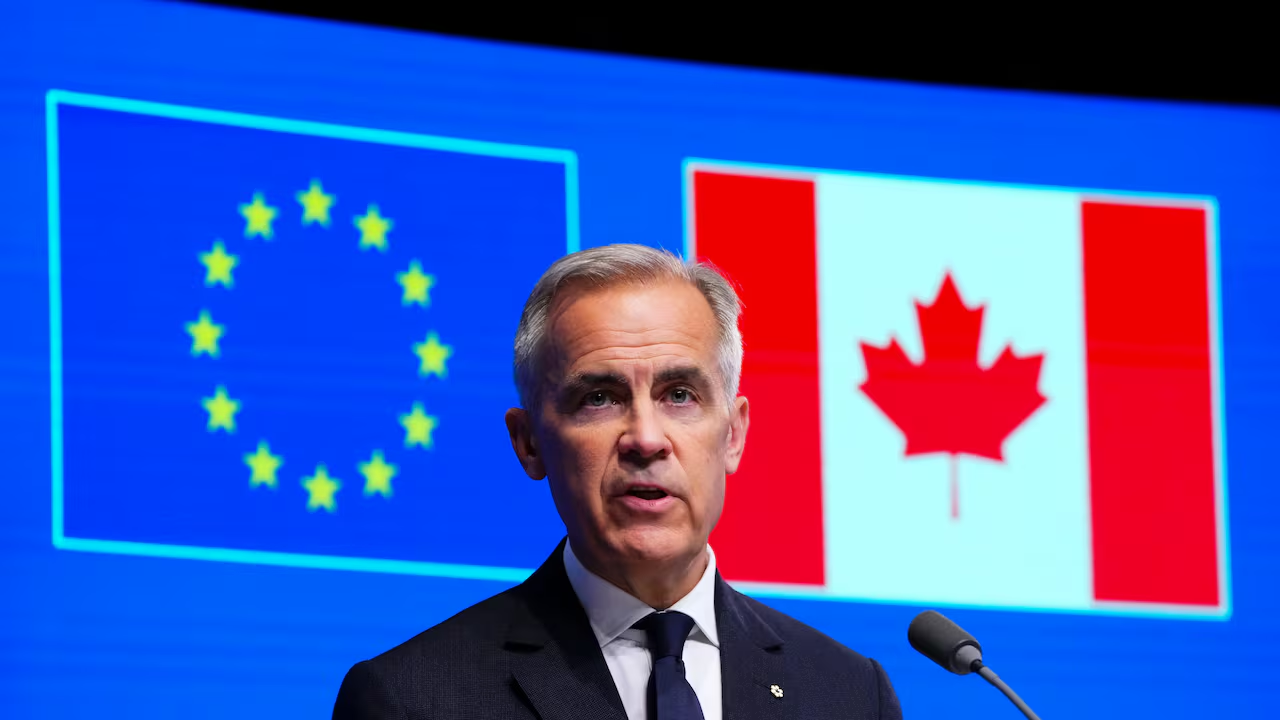
A plain-language guide to the "associate member" story, what Ottawa has confirmed, what it has denied, and which pieces are still unwritten before the Montreal summit.
The push for a closer Canada-EU alliance moved from diplomatic shorthand to front-page politics over a single weekend, after a Wall Street Journal report said Prime Minister Mark Carney was pressing officials to elevate Ottawa’s relationship with the 27-nation bloc — including adopting the title “Associate Member of the European Union.” Carney responded publicly on Sunday, September 14, 2026, saying Canada is not seeking membership but does intend to open discussions on what he called a “unique alliance,” days before his scheduled address to the European Parliament.
What followed was a fast-moving argument conducted largely without a document. There is no published text, no signed agreement and no legal definition of the term at the centre of the dispute. Here is what has actually been confirmed, what has been denied, and what remains genuinely unsettled.
What Carney Said at TIFF About the Canada-EU Alliance
Speaking on the sidelines of the Toronto International Film Festival, Carney flatly rejected the idea that Canada is applying to join the European Union. “We’re not looking to become a member of the European Union,” he said, adding that officials are instead preparing to begin discussions on a closer arrangement.
His reasoning leaned on alignment rather than institutions: “We share the same values, we have the same priorities, and we have very complementary strengths.” It was not a new position. As far back as June 2025, Carney said he wanted the two sides to “co-operate much more clearly and broadly to our mutual benefit” — “not as a member, but along that continuum.”
On August 22, 2026, he went further, saying Canada and the EU would spend the fall discussing a “much stronger and deeper” security and economic partnership.
The Wall Street Journal Report and the ‘Associate Member’ Label
The Saturday report that triggered the weekend’s exchanges said Carney was pushing his team to take Ottawa’s relationship with Brussels “to the next level,” with the proposed new title of “Associate Member of the European Union.” It also carried a widely circulated line from Finnish President Alexander Stubb: “Wouldn’t it be lovely if Canada was the 28th state of the European Union rather than the 51st state of the United States?”

A senior Canadian official, speaking to CBC News on a not-for-attribution basis, pushed back on the framing. The “associate member” label, the official said, was one of several options under consideration — and it was not proposed by Canada.
That distinction matters for how the story is read. A branding exercise floated in a negotiating room is not the same as a formal Canadian request, and neither side has released terms.
Why ‘Associate Member’ Carries No Legal Weight
The phrase is not a legal designation within the European Union’s treaty architecture. It describes a relationship rather than a status, which is precisely why it can be attached to very different bundles of co-operation — and why critics and supporters can each read into it what they expect.
The same official said Ottawa conducted a detailed review of how the EU handles its closest non-members — Norway, Switzerland, the United Kingdom and Georgia — and concluded that none of those templates fit. The common obstacle was sovereignty: the Canadian government is not prepared to surrender independence in exchange for market access.
That rules out, by Ottawa’s own account, the European Economic Area-style trade-off in which access is purchased with rule-taking. Whatever emerges would have to be built rather than borrowed.

Poilievre and the ’28th EU State’ Warning
Conservative Leader Pierre Poilievre and other Conservative MPs responded on X on Sunday, saying Canadians should be concerned about becoming the “28th EU state.” The line echoed Stubb’s quote and turned an abstract diplomatic question into a sovereignty argument aimed squarely at voters.
Former Liberal leader and Special Envoy to the European Union Stéphane Dion took the opposite view, saying the idea of Canada joining the EU “will never happen.” His emphasis was commercial rather than constitutional: Canada must raise its trade with the EU above eight per cent, and on that goal, he argued, Conservatives and Liberals “should all agree it’s the thing we need to do.”
The broader political backdrop is difficult to separate from the diplomacy. Both Ottawa and Brussels are managing pressure from Washington, a dynamic Canadian readers have watched play out through this year’s Canada-U.S. trade negotiations and Carney’s stated red lines.
What Canada and the EU Have Already Signed
Any new framework would sit on top of an existing stack of agreements, not replace it. Three are central to the current discussion.
- CETA: the Comprehensive Economic and Trade Agreement, which remains only partially applied.
- The Strategic Partnership Agreement: the non-trade political framework covering co-operation outside commerce.
- The Security and Defence Partnership: signed in June 2025, the newest and most consequential addition.
Geneviève Tuts, the EU’s ambassador to Canada, and Carney have both reached for the same adjective — “unique” — to describe what comes next. Tuts has also said the shape of it is still being worked out, and that at this stage she expects discussions rather than a finished deal.

Energy, AI, Critical Minerals and Defence on the Table
According to the Wall Street Journal report, Canada and the EU are examining ways to move closer on energy, artificial intelligence, critical minerals and defence. The Canadian official added a citizen-facing dimension: the aim is to widen the options Canadians have for where they study, travel, do business and retire.
Achim Hurrelmann, co-director of the Centre for European Studies at Carleton University, said the package appears to be assembled quickly, and sketched out what it might realistically contain — collaboration on a European stockpile of critical minerals, university student exchanges through the Erasmus program, and a digital trade agreement.
The minerals element connects to a file Canada has been actively marketing to international capital, including at the Canada Investment Summit that produced close to $500 billion in new commitments. For Canadian resource and technology firms, a European stockpile arrangement would be one of the more commercially concrete outcomes on the list.
The Substance Question: ‘Lots of Initiatives’ or a Real Step Change?
Hurrelmann’s caution is the most important analytical note in the story so far. He suggested the result may be a series of smaller agreements rather than one landmark pact — or, less charitably, a grab bag of ideas gathered under a heading such as “co-operating on strategic capabilities.”
“There are lots of initiatives, but they don’t at this point really amount, from what I can see, to this systematically new step in the relationship,” he said. “I’m not really sure if the substance will actually justify the new label.”

That is the test worth applying to whatever is announced: does the content change, or only the branding? Readers should treat unconfirmed descriptions of the arrangement — including any specific title — as provisional until official text is released by both sides.
From the European Parliament Speech to the Montreal Summit
The timeline is short and public. European Commission President Ursula von der Leyen was scheduled to speak on the Wednesday, with Carney addressing the European Parliament on Thursday morning. Von der Leyen has since said she wants Canada to become the bloc’s first associate member, moving the phrase from anonymous briefing to open political commitment on the European side.
The next formal checkpoint is the Canada-EU summit in Montreal at the end of October, where the Canadian official said the government hopes to sketch out the relationship more clearly. Further discussions on the shape of the partnership are expected there.
Until then, the gap between the two capitals is less about direction than definition. Both say they want something closer than a trade deal and short of membership. Nobody has yet published what that is.
Frequently Asked Questions
Is Canada applying to join the European Union?
No. Carney has said repeatedly, including in June 2025 and again on September 14, 2026, that membership is not the plan.

Does “associate member” mean anything under EU law?
No. It is not a legal designation, which is why the content of any arrangement matters more than the title attached to it.
Did Canada ask for the “associate member” title?
A senior Canadian official said the label was one of a few considered and that Canada did not propose it. Von der Leyen has since said publicly she wants Canada to be the bloc’s first associate member.
Why won’t the Norway or Switzerland model work for Canada?
Ottawa reviewed the EU’s arrangements with Norway, Switzerland, the U.K. and Georgia and concluded none fit, because Canada does not want to trade away independence for access.
When will details actually be known?
The Canada-EU summit in Montreal at the end of October is the point at which the government says it hopes to define the relationship more clearly.


