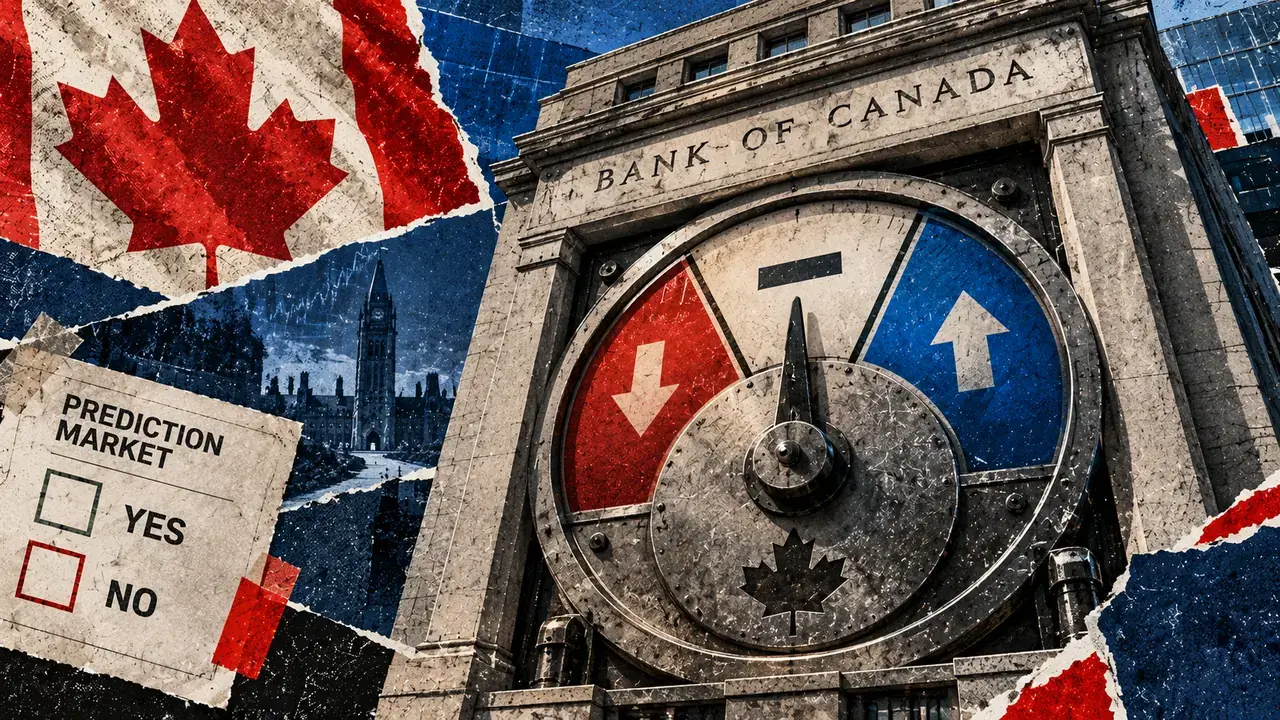
Prediction market traders give an October 28 pause better than five-to-one odds, and one inflation report due nine days earlier could change that.
The Bank of Canada interest rate decision scheduled for October 28 is shaping up as a test of how long policymakers can afford to wait. Traders on one prediction market currently put the odds of the overnight rate staying at 2.25 per cent above 85 per cent. They are betting that inflation running at 3.0 per cent outweighs a softening job market, at least for now.
The case is not one-sided. Fresh labour figures released on October 9 showed unemployment climbing and tens of thousands of jobs disappearing. Those numbers strengthen the argument for relief and make a prolonged pause harder to justify.
Prediction Market Odds Point to the Overnight Rate Staying at 2.25%
On Polymarket, the October contract tied to the central bank’s announcement showed a clear favourite as of October 13. Market participants assigned a hold a probability of 85.2 per cent. The only other outcome with meaningful backing was a quarter-point increase, not a cut.
| Outcome on October 28 | Market-implied probability | Trading volume |
|---|---|---|
| No change | 85.2% | $63.76K |
| 25 basis point increase | 14.8% | $52.3K |
| 50+ basis point increase | 0.1% | $20.46K |
| 25 basis point decrease | 0.1% | $23.74K |
| 50+ basis point decrease | 0.1% | $10.48K |
Across all outcomes, the market had recorded about $170,740 in total volume, with $36,380 in available liquidity and $29,880 in open interest. The contract settles on the change in basis points to the Bank’s target for the overnight rate, measured against the level in place before the announcement. The Bank of Canada’s own published decision serves as the settlement source.
The pricing carries one notable feature. Despite weak employment data, traders give a rate hike roughly 150 times the probability of a rate cut. That suggests participants are more worried about stubborn prices than about a slowing economy.
August Inflation at 3.0% Sets a High Bar for Easing
Statistics Canada reported annual consumer price inflation of 3.0 per cent in August 2026. For general context, the Bank targets 2 per cent inflation and treats 1 to 3 per cent as its control range. That puts the August reading at the top edge of what the central bank considers acceptable.
A reading that high gives policymakers reason to ask for more evidence before lowering borrowing costs. Any cut would need a convincing explanation of why weaker economic conditions matter more than the risk that price pressure lingers. That is an inference about the trade-off, not a stated position from the Bank.
The headline figure leaves important questions open. The available data do not show which components drove the increase or whether price gains are spreading across categories. That distinction matters:
- If pressure is narrow and temporary: the 3.0 per cent figure becomes a weaker obstacle to easing, because it may fade without help from higher rates.
- If price gains are broadening: the case for holding grows stronger, since it becomes harder to argue that a cooling job market will bring inflation down quickly.
September Job Losses and 6.5% Unemployment Build the Case for a Cut
The September Labour Force Survey, released October 9, pulled in the opposite direction. Employment fell by 68,000, and the unemployment rate rose to 6.5 per cent. The participation rate slipped to 64.8 per cent.

The combination is more telling than any single figure. When participation falls, fewer people are counted as working or actively looking for work, which on its own would tend to hold the jobless rate down. Unemployment rose anyway, which suggests demand for workers may be softening in a real way.
If that reading is correct, waiting has a price. Holding the rate at 2.25 per cent while policymakers seek greater confidence on inflation could prolong pressure on businesses and households. Readers following how lenders are already positioning can see our look at what Scotiabank’s posted rates reveal about the rate outlook.
The counterargument is that one month of data cannot establish how deep or durable the slowdown is. Details on hours worked, wage growth and sector-by-sector changes would help show whether September marks broad deterioration or a narrower adjustment. A firm case for cutting depends on the weakness running deeper than the headline figures.
October 19 CPI Release Is the Last Major Data Point Before the Decision
The calendar may matter as much as the numbers. Statistics Canada will publish September consumer price data on Monday, October 19, nine days before the announcement. Business-survey releases are also expected that day.
By contrast, the next Labour Force Survey does not arrive until November 6, after the decision. That report will cover the reference week of October 11 to 17, but it will land too late to inform the October 28 call. In practice, policymakers will judge inflation with a fresh reading while relying on September’s labour picture.
The October 19 releases could resolve the tension or deepen it. Possible combinations include:
- Softer inflation plus weaker business demand: both sides of the easing argument would reinforce each other, putting pressure on the hold case.
- Firmer inflation plus resilient business conditions: the argument that September’s job losses demand an immediate response would lose force.
- Firm inflation plus deteriorating business conditions: policymakers would face competing risks, which would likely keep a pause on the table.
Survey readings on hiring, demand and price-setting could help separate these scenarios. No results are available yet.
Why a Thin Market Could Swing Quickly
The headline probability should be read with care. Liquidity in this contract, about $36,000, is well below its total trading volume of roughly $171,000. That gap suggests the quoted price may reflect a relatively small pool of active money rather than a broad, settled consensus.
Limited depth tends to amplify moves. A surprise in the October 19 inflation data could shift the odds sharply in either direction. Prediction market prices are not forecasts from the Bank or from economists, and they can change rapidly as new information arrives.
Market odds cited here are third-party figures that change constantly. They are reported for news purposes only and are not financial, investment or trading advice.
Canada’s Call Comes in a Busy Week for Central Banks
The Bank of Canada will not be deciding in isolation. Traders expect a quiet week across major central banks, based on comparable prediction markets:
- U.S. Federal Reserve, October 29: no change at 80.5 per cent, a 25-basis-point increase at 19.5 per cent and a 25-basis-point cut at 0.6 per cent, on volume of about $33.72 million.
- European Central Bank, October 30: no change at 90.5 per cent and a 25-basis-point increase at 9.5 per cent, on volume of about $547,540.
- Bank of Japan, October 30: no change at 95.1 per cent, a 25-basis-point increase at 4.3 per cent and a hike of 50 basis points or more at 0.7 per cent, on volume of about $197,280.
The pattern is consistent. Traders see holds as the default almost everywhere, with any residual risk tilted toward tightening rather than easing. For Canadian borrowers and businesses, a pause on October 28 would keep financing costs steady heading into year-end. The decision also falls amid a stream of corporate results, which we cover in our piece on why the first earnings reports matter for Canadian readers.
Frequently Asked Questions
When is the next Bank of Canada interest rate decision?
The Bank’s next scheduled announcement is on October 28, 2026.
What is the current policy rate?
The overnight rate target stands at 2.25 per cent.
What data could change expectations before the decision?
September consumer price figures and business-survey releases, both due October 19, are the main pre-decision data points.
Will October jobs data be out before the announcement?
No. The next Labour Force Survey is scheduled for November 6, after the decision.

The Brand Magazine Newsroom covers Canadian business, markets and policy news for brand builders and entrepreneurs. Newsroom reports are produced from published public sources such as company releases and government and regulator publications, and follow our Editorial Standards.