A leader-by-leader breakdown of the closing arguments, the referendum fight that dominated the last weekend, and the seat thresholds worth watching as Quebec votes.
With one day left in the Quebec election campaign, the leaders of the province’s five major parties fanned out across Quebec on Sunday, Oct. 4, 2026, to deliver closing arguments before polls open Monday. Their messages diverged sharply, but a single question ran through almost all of them: whether Quebecers are prepared to elect a government that has committed to holding a sovereignty referendum within its first term.
The Parti Québécois enters voting day as the front-runner, according to published polling, while the governing Coalition Avenir Québec is seeking a fourth consecutive mandate after eight years in office. The Liberals, Conservatives and Québec Solidaire each spent the final hours making a case for why their seats matter in the legislature that emerges Monday night.
St-Pierre Plamondon Spends His Last Day in the Montreal Region
Parti Québécois Leader Paul St-Pierre Plamondon framed the vote squarely as a referendum on the CAQ’s record, arguing that Quebecers are looking for a break from eight straight years of the same government. “I hope that tomorrow there will be a significant change in direction, and I think that’s what the people of Quebec are expecting,” he said, adding that he believes his party is the only one able to deliver it.
Rather than defend ground where the PQ is already strong, St-Pierre Plamondon closed the campaign in the Montreal region — an area where the party has recorded some of its weakest results over the past decade, and where it now hopes to flip seats. He urged volunteers and supporters to spend the final 24 hours chasing undecided voters.
That late focus is consistent with what the public numbers have shown through the campaign. Our earlier look at how the polls kept the Parti Québécois in front underlines why the party spent its closing hours trying to convert soft support in the province’s largest urban region rather than shoring up its base.
The PQ’s First 100 Days: Homelessness, Red Tape and the Gas Tax
St-Pierre Plamondon has set out a short list of priorities for a PQ government’s opening months. According to his own stated plan, the first 100 days would centre on:
- A dedicated homelessness budget: a special allocation identified as his top early priority.
- Cutting red tape: reducing administrative burden across government.
- Abolishing taxes on used goods: removing the levy applied to second-hand purchases.
- Lowering the gas tax: a direct cost-of-living measure at the pump.
- Reinvesting in community groups and food banks: restoring funding to front-line organizations.
Notably absent from that opening list is the referendum itself, which the party has committed to holding before the end of a first mandate — a sequencing his rivals spent the weekend highlighting.
Christine Fréchette’s Regret: Not Pressing the Referendum Warning Harder
Coalition Avenir Québec Leader Christine Fréchette positioned her party as the only alternative to Quebec’s long-running sovereigntist-versus-federalist split, pitching nationalism paired with economic growth inside Canada. She said she was proud of the campaign her team ran, but offered an unusually candid assessment of what she would have done differently.
Her regret, she said, was not placing more emphasis on the threat a referendum poses. “It’s important for people to realize this, because it’s not just a decision that could affect Quebec in three years,” she said. “There will be impacts because uncertainty will become part of Quebec’s political and economic calendar.”
Fréchette, whose party has been trailing in polling, planned to spend part of the final full campaign day door-knocking in Trois-Rivières, the riding where she is seeking a seat.
Why the Referendum Question Took Over the Final Weekend
The PQ’s commitment to a sovereignty vote before the end of a first term turned the closing stretch into an argument about consequences rather than platforms. For the CAQ, the Liberals and the Conservatives, the pitch was less about their own programs than about what a PQ win would set in motion.
Fréchette’s framing — that uncertainty would become a fixture of Quebec’s economic calendar — is the argument most likely to resonate with business audiences, who already watch rate and currency decisions closely. Readers tracking that side of the story may want to compare it with the forecasts building ahead of the Bank of Canada’s Oct. 28 decision, which has its own bearing on borrowing costs in the province.
It is worth being precise about what is and is not confirmed here: no referendum date has been set, and the only commitment on the record is the PQ’s stated intention to hold one within a first mandate. Everything beyond that remains speculation until a government is formed.
Charles Milliard Asks Federalists to Vote Strategically
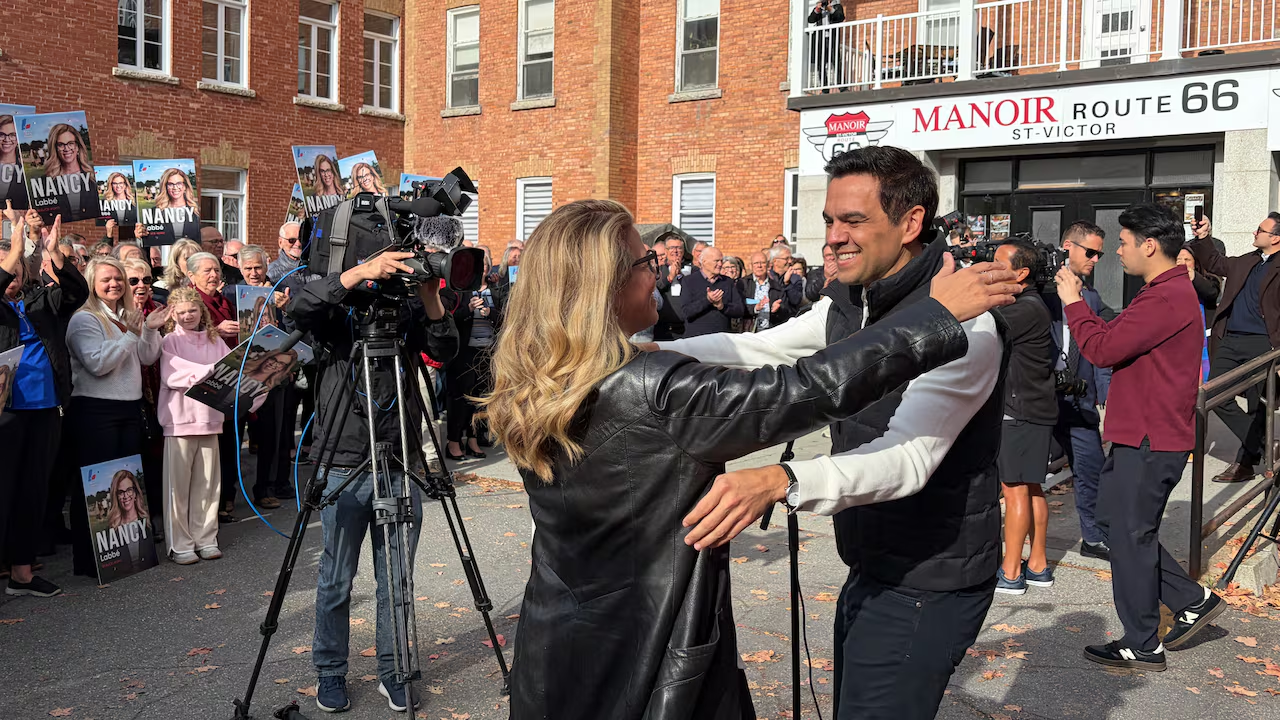
Quebec Liberal Party Leader Charles Milliard made the bluntest appeal of the day, describing his party as the only federalist option on the ballot and urging voters who want to keep the PQ out of power to back Liberal candidates tactically.
He argued that even a PQ minority would go looking for referendum support among the other parties in the legislature. “One party that Mr. St-Pierre Plamondon won’t be calling up is Liberal Party of Quebec, because we’re proudly federalist and not ashamed to say it,” he said.
Speaking at a campaign stop in Saint-Victor, Que., Milliard said his party had built momentum since the opening days — a period when he drew criticism for not appearing in a photo on his own campaign bus, an omission later corrected. He also suggested the Liberal vote was likely “underestimated” in certain regions, a claim Monday’s count will test directly.
Éric Duhaime Sets a 12-Seat Target for Official Party Status
Conservative Leader Éric Duhaime spent the eve of the vote touring an orchard and local market in Saint-Henri, Que., asking supporters to turn out in sufficient numbers to give his party a real voice in the National Assembly. He has said he hopes to win at least 12 seats — the threshold for official party status — after the Conservatives took none in 2022.
Duhaime has promised to use any leverage he gains as a “guard dog” for taxpayer interests and to try to block a referendum vote. “I’m very, very serene, and I have confidence,” he said. “The only thing is, we have to make sure people go out and vote.”
Official party status matters beyond prestige. In practice it governs access to research budgets, speaking time in the chamber and committee participation — which is why a 12-seat result would change the Conservative role far more than an 11-seat one.
Ruba Ghazal Courts Progressive Sovereigntists in Montreal
Québec Solidaire co-spokesperson Ruba Ghazal campaigned in Montreal, targeting progressive sovereigntist voters who are drawn to independence but not to what she characterized as the austerity on offer from the PQ and other parties, including Duhaime’s Conservatives.
“Send a signal that not all of Quebec has swung to the right or turned conservative, and also send people who will be the only ones to stand up to Éric Duhaime’s influence in the next parliament,” she said. Her appeal sets up a direct competition with the PQ for sovereigntist votes in Montreal ridings — the same region where St-Pierre Plamondon spent his final day.
The Five Closing Arguments at a Glance
| Leader | Party | Closing message |
|---|---|---|
| Paul St-Pierre Plamondon | Parti Québécois | Change after eight years of CAQ government; last push for undecided voters |
| Christine Fréchette | Coalition Avenir Québec | Nationalism and growth within Canada; warning on referendum-driven uncertainty |
| Charles Milliard | Quebec Liberal Party | The only federalist option; strategic voting to block a PQ government |
| Éric Duhaime | Conservative Party of Quebec | Win 12 seats for official status; act as a “guard dog” against a referendum |
| Ruba Ghazal | Québec Solidaire | A progressive sovereigntist alternative to austerity and to the right |
The Numbers That Will Define the Quebec Election Result
Three thresholds are worth watching as results come in Monday. The first is whether the PQ converts its polling lead into Montreal-region seats, the test St-Pierre Plamondon set for himself by campaigning there on the final day. The second is whether the Conservatives clear 12 seats, which would transform them from a party with no legislature presence into a recognized caucus.
The third is the shape of the government itself. Milliard’s warning about a PQ minority only becomes relevant if the PQ falls short of a majority — in which case the arithmetic between the PQ, Québec Solidaire and the Conservatives would determine how much room a referendum commitment actually has to move forward.
Frequently Asked Questions
When is the Quebec provincial election?
Voting takes place Monday, Oct. 5, 2026, following the final day of campaigning on Sunday, Oct. 4.
Has a referendum date been announced?
No. The Parti Québécois has committed to holding a sovereignty referendum before the end of a first term in government, but no date has been set.
Why does 12 seats matter for the Conservatives?
Twelve seats is the threshold Éric Duhaime has identified for official party status, which carries added resources and standing in the legislature. His party won no seats in 2022.
Which leaders are running for seats themselves?
The source material confirms Christine Fréchette is running in Trois-Rivières. Riding details for the other leaders were not specified.
What would the PQ do first if elected?
St-Pierre Plamondon has said his first 100 days would prioritize a special homelessness budget, cutting red tape, abolishing taxes on used goods, lowering the gas tax, and reinvesting in community organizations and food banks.

The Brand Magazine Newsroom covers Canadian business, markets and policy news for brand builders and entrepreneurs. Newsroom reports are produced from published public sources such as company releases and government and regulator publications, and follow our Editorial Standards.