


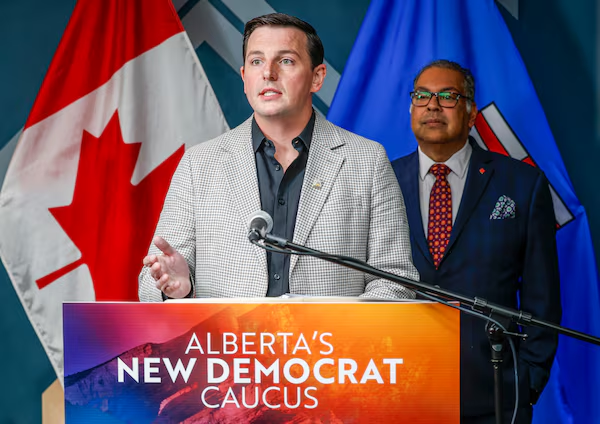
How a 582-vote by-election loss in one of Calgary's safest conservative seats turned into a referendum on Danielle Smith's handling of separatism.
Backlash to the Alberta separation referendum has cost the governing United Conservative Party one of Calgary’s most dependable seats. Alberta NDP candidate Kyle Campbell won the Calgary-Shaw provincial by-election late on Monday, Sept. 14, 2026, taking roughly 47 per cent of the vote and defeating UCP candidate Mike Derry by 582 votes, according to preliminary results from Elections Alberta. The result landed five weeks before Albertans vote on Oct. 19 on whether to remain in Canada, and it immediately reframed that referendum as a political liability for Premier Danielle Smith rather than a rallying point.
Campbell’s win is only the second time the New Democrats have carried Calgary-Shaw, and the first since 2015. Premier Smith’s office attributed the loss to a divided conservative vote and weak turnout. Political strategists and former officeholders from across the spectrum described something broader: a protest vote aimed squarely at the existence of the independence referendum.
A 582-Vote Margin in a Seat the UCP Won by 14 Points
The scale of the swing is what made the night unusual. Calgary-Shaw, in the city’s south, had been safe conservative ground through two consecutive general elections under the UCP, which was formed in 2017 through the merger of the Progressive Conservatives and the Wildrose Party.
- 2019 general election: the UCP defeated the NDP in the riding by a 40-percentage-point margin.
- 2023 general election: the UCP took 56 per cent of the vote, a 14-point margin.
- 2026 by-election (preliminary): NDP candidate Kyle Campbell won with roughly 47 per cent, ahead of the UCP’s Mike Derry by 582 votes.
Two smaller parties also registered on the unofficial count. The newly formed Progressive Tory Party of Alberta recorded 978 votes, and the Alberta Liberal Party — largely absent from provincial contention for years — took 602 votes. Both totals exceed the NDP’s margin of victory, which is the arithmetic behind the Premier’s office pointing to a fragmented right.
Why the Seat Was Vacant
The by-election was triggered by the resignation of former cabinet minister Rebecca Schulz, who had held Calgary-Shaw for the UCP. Off-cycle contests in safe seats are normally low-drama affairs used to test messaging and refresh a caucus. In this case, the vacancy handed voters a mid-term ballot at the exact moment the province’s constitutional future dominated the news agenda.

That timing matters for how the result should be read. By-elections routinely punish governments without predicting general elections, and turnout patterns amplify the effect. The open question in Alberta is whether Calgary-Shaw was a one-off release valve or the leading edge of a shift in the province’s urban politics — a question closely tied to the broader debate over the economic and constitutional cost of secession.
Turnout of 38 Per Cent, and Which Voters Stayed Home
Roughly 38 per cent of eligible voters cast ballots. That is far below the 63 per cent turnout recorded in the 2023 provincial general election, but several percentage points higher than recent Alberta by-elections — an unusual combination that suggests engagement was elevated for this type of contest even as most voters sat it out.
The composition of that turnout is the more consequential figure. Compared with the last general election, UCP supporters showed up in significantly lower numbers than NDP supporters. In a riding the UCP has won comfortably twice, differential turnout alone can erase a double-digit cushion without a single voter formally switching allegiance.
Smith’s Office Blames a Split Right; Nenshi Calls It a “Shockwave”
Sam Blackett, spokesperson for the Premier, pinned the outcome on a fragmented conservative vote and lower participation, and emphasised the need for unity on Alberta’s right. “In 5 weeks, the referendum vote will be over, and we’re confident Albertans will be ready to move forward and fight for a stronger Alberta within a united Canada,” he wrote in an emailed statement.

Alberta NDP Leader Naheed Nenshi described the win as a “shockwave that ran through Alberta politics.” Appearing alongside Campbell at a Tuesday morning news conference, he argued the result was more than anti-government sentiment: “This was a vote against Danielle Smith, but we wouldn’t have won if it was a vote against Danielle Smith alone. This was a vote for the Alberta NDP.”
Our earlier report on the night itself, the Calgary-Shaw by-election result and how the NDP took a UCP stronghold, covers the count and the immediate reaction in more detail.
“An Albatross Around Her Neck”: How Strategists Read the Referendum Effect
Michael Solberg, a former staffer to prime minister Stephen Harper and a partner at New West Public Affairs, called the outcome “an astonishing result” and said several factors were in play, but that voter feeling about the Oct. 19 vote appeared to be connected. “I think it is an albatross around her neck right now,” he said of the Premier.
Solberg also framed the timing as a reprieve. “The party is lucky there’s not a general election in the next five weeks. But there is a huge opportunity for the Premier to turn the page in five weeks,” he said.

Shannon Phillips, a former Alberta NDP MLA and ex-provincial environment minister, said the win surprised her given the area’s record of electing conservatives, but that frustration with the referendum itself had spread widely. “This was a protest vote against the very existence of the referendum,” she said. On whether the momentum holds: “No event is ever fixed in time, and it depends on who’s going to do politics.”
The Bind Inside the UCP Over Alberta Independence
The referendum has left Smith positioned awkwardly within her own coalition. She has declared herself a federalist who favours a “sovereign Alberta within a united Canada” and says she will vote to remain in Canada. She also leads a party increasingly shaped by vocal separatists, and critics argue that faction exerts influence out of proportion to its size.
Former premier Jason Kenney, the UCP’s first leader and one of the loudest pro-Canada voices, issued a blunt warning in a Tuesday social-media post: “A vote to separate is a vote to help the NDP win the next provincial election, and for the Liberal Party of Canada to win far more Alberta seats.”
Evan Menzies, vice-president at Crestview Strategy and a former UCP director of communications who also served as communications director for the Wildrose Party under Smith in the early 2010s, called the referendum a “lead balloon for a large segment of the Alberta population.” He expects the damage to fade. “I don’t see it as I’ve seen others lay it out, as a permanent shift in Alberta politics,” he said, adding that a decisive pro-Canada win in October should let the government move on. “I don’t think it will be dominating the election landscape in October, 2027.”

What the Oct. 19 Ballot Actually Decides
Albertans will not be voting to leave Canada on Oct. 19. The ballot asks whether the province should remain in Canada or lay the legal groundwork for a second, binding secession vote — a two-stage design that means an affirmative result would open a process rather than complete one. Polling has consistently shown a large majority of Albertans reject separatism.
For businesses and investors, that distinction is the practical one. A staged process implies an extended period of constitutional and legal uncertainty rather than an immediate rupture, which is why the question is being watched alongside other national files reshaping Canada’s economic position, including the federal government’s proposed closer alignment with the European Union.
Official Results Due Sept. 24
The Calgary-Shaw numbers remain preliminary. Official results from Elections Alberta are expected on Sept. 24, which will confirm the 582-vote margin and the final party tallies. Campbell takes his seat as MLA for the riding once the count is certified. The referendum vote follows on Oct. 19, with the ballot count for the independence question expected to run deep into the following morning.
Frequently Asked Questions
Are the Calgary-Shaw results final?
No. The figures reported are preliminary results from Elections Alberta, with official results due Sept. 24, 2026.

Does a Yes vote on Oct. 19 mean Alberta leaves Canada?
No. The question asks whether Alberta should remain in Canada or lay the legal groundwork for a second, binding secession vote, so the October ballot would begin a process rather than complete separation.
Why was there a by-election in Calgary-Shaw?
The seat became vacant after former cabinet minister Rebecca Schulz resigned.
How did smaller parties perform?
On the unofficial count, the newly formed Progressive Tory Party of Alberta took 978 votes and the Alberta Liberal Party took 602 votes — both totals larger than the NDP’s 582-vote winning margin.
When is the next Alberta general election expected?
Commentators quoted in this story referenced an October 2027 election landscape; no firm date is specified in the available information.


