

A guide to what is actually happening when "Things Fall Apart" takes over galleries, a TTC platform, a tall ship and a Scarborough gurdwara for 12 free weeks.
The Toronto Biennial of Art 2026 opens to the public on Saturday, September 26, launching a 12-week, admission-free edition titled Things Fall Apart that runs through December 20 and spreads across more than 13 venues in Toronto and partner regions. It is the fourth edition of the city-wide contemporary art event, curated by Allison Glenn, and it arrives with newly commissioned works, street processions, a performance staged on Lake Ontario and a billboard installed on a TTC subway platform.
The Biennial’s operating premise has not changed: commission artists to make new work in direct dialogue with Toronto’s local contexts, then give the public free access to it. What has changed is the curatorial lens. This edition asks what happens when systems break, and what gets built in the gap.
What “Things Fall Apart” Actually Argues
Glenn’s framework centres on artists who treat rupture as a generative force rather than an ending. In practice, that means projects that reconsider histories, geographies and the systems shaping contemporary life, and that propose different ways of reading the present rather than simply documenting a breakdown.
The Biennial has published its full slate of Artist Projects online, including which commissioned works are tied to the 2026 curatorial framework and which site each artist will occupy. For visitors trying to plan around a 12-week window and a dispersed map, that site-by-site listing is the practical starting point.
One of the announced commissions is Naotaka Hiro’s Untitled (Solvent) (2025), a 262 × 213.5 cm work in canvas, fabric dye, oil pastel, rope and grommets. It was commissioned by the Toronto Biennial of Art, co-presented with the Art Museum at the University of Toronto, and made possible with support from Eleanor and Francis Shen — a reminder of how much of this programming rests on named private philanthropy alongside institutional partners.

Rebecca Belmore Opens With a Procession From Queen’s Park
The first major public moment lands at noon on opening day. Rebecca Belmore’s new work Gichigami begins as a procession moving from Queen’s Park to the University of Toronto, where it then settles into the Art Museum as an installation for the remainder of the run.
Staging the debut as a walk rather than a gallery unveiling is consistent with the Biennial’s stated intent to meet audiences in shared civic space. The event is free, with registration through the Biennial’s website.
Raphaël Barontini’s Carnival Parade on the U of T Campus
Two hours later, at 2:00 p.m. on September 26, Raphaël Barontini presents Konvwa libèté, a carnival-style street parade that gathers in front of Hart House at 7 Hart House Circle. The procession features percussion, indigo costumes, banners and flags, and is co-presented with the Toronto Caribbean Carnival, Hart House and the Art Museum.
The co-presentation is notable on its own terms. Pairing a Biennial commission with the Toronto Caribbean Carnival connects a contemporary art programme to one of the city’s largest and longest-running cultural institutions, and puts the work in front of an audience that does not necessarily arrive through gallery channels.

Brendan Fernandes Stages The Calls Aboard the Tall Ship Kajama
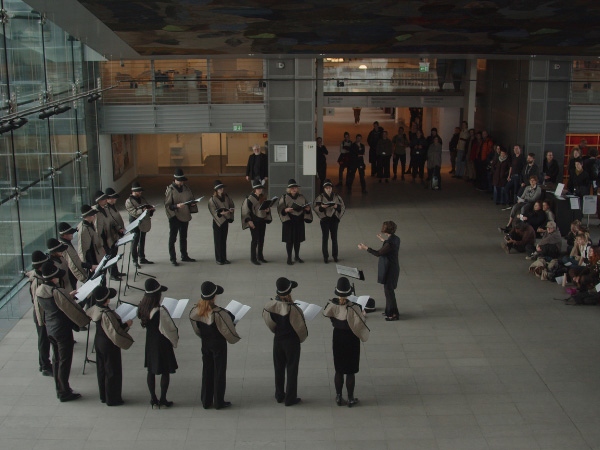
On Sunday, September 27, Brendan Fernandes brings The Calls (Toronto) to the Tall Ship Kajama, docked behind Harbourfront Centre and The Power Plant. Co-presented with TO Live, the piece is an immersive sonic and movement performance staged on Lake Ontario, featuring contemporary dancers and an 18-voice Modern Sound Collective choir.
Two sailings are scheduled, at 12:00 p.m. and 2:15 p.m. Both are free with registration. Capacity on a working tall ship is inherently limited, so this is one of the opening-weekend programs where advance booking matters most.
The Speculative Futures Panel at Harbourfront Centre
Also on September 27, at 10:30 a.m. in the Harbourfront Centre Studio Theatre, Glenn moderates In Dialogue: Speculative Futures with artists Andrés Ramírez Gaviria, Carolina Fusilier, Lindsay Katsitsakatste Delaronde and Regina de Miguel. The conversation covers time, science fiction, Indigenous epistemologies and speculative futures.
The panel functions as the intellectual key to the edition — the place where the curatorial framing gets argued out loud rather than left to wall text. Attendance is free, with registration required through the Biennial’s website.

Thirteen-Plus Sites, From the CN Tower to a Scarborough Gurdwara
The Art Museum at the University of Toronto — comprising the University of Toronto Art Centre and the Justina M. Barnicke Gallery — serves as the main exhibition hub and primary learning space. From there the programme fans out across institutional, commercial and everyday civic locations.
| Site | Note |
|---|---|
| Art Museum at the University of Toronto | Main exhibition hub and primary learning space |
| Art Gallery of Ontario | Partner site |
| Aga Khan Museum | Partner site |
| Billboard, St. George TTC Station | Westbound platform, Bloor-Danforth line |
| CN Tower | Partner site |
| Gallery TPW | Partner site |
| Harbourfront Centre | Partner site |
| Midnight Moment, Times Square Arts, New York City | Month of November only |
| Mercer Union, a centre for contemporary art | Partner site |
| Royal Ontario Museum | Partner site |
| Sankofa Square | Partner site |
| Scarborough Gurdwara | Partner site |
Two entries on that list are worth pausing on. The St. George subway billboard puts a commissioned work in the daily path of commuters who never planned to see art, and the November-only slot in Times Square Arts’ Midnight Moment gives a Toronto-commissioned project a New York audience — an export channel few Canadian visual arts events have.
The Ticketed Opening Party and a Date Worth Double-Checking
Separate from the free public programming, the Biennial is holding a ticketed fundraiser at the Art Museum at the University of Toronto, beginning at 7:00 p.m. and sponsored by EY. Guests get early access to the main partner site and celebrate alongside the 2026 artists and partners, with artist performances on the bill.
The announcement lists the party as Friday, September 2, 2026, which sits outside the September 26 to December 20 run. Ticket prices were not specified in the announcement, and readers planning to attend should confirm the date directly with the Biennial before booking travel around it.

Why a Free Biennial Is a Serious Business Story
Free admission is the central editorial decision here, and it is an expensive one. Removing the ticket line shifts the entire revenue burden onto sponsorship, philanthropy, public funding and fundraisers like the EY-backed opening party — the model visible throughout this edition’s credits, from named commission donors to institutional co-presenters such as TO Live and the Toronto Caribbean Carnival.
As general sector context, large recurring visual arts events are typically justified to funders on tourism, hospitality and downtown foot-traffic grounds as much as on artistic merit. A 12-week window spanning autumn into the December holiday season, anchored at high-traffic sites including the AGO, ROM, CN Tower and Harbourfront Centre, is well positioned to capture that argument. No attendance projections or budget figures were included in the announcement, so any economic impact claim for this specific edition remains unquantified.
What Visitors Should Do Before September 26
- Check the Programs Calendar: the opening-weekend items listed above are a selection, not the full slate.
- Register early for capacity-limited events: the Kajama sailings, the Belmore procession, the Barontini parade and the Harbourfront panel all require registration despite being free.
- Plan by site, not by artist: the Biennial’s Artist Projects pages list which venue holds each work, which matters when the map runs from downtown to Scarborough.
- Note the November-only entry: the Times Square Arts Midnight Moment presentation runs for that month alone.
Frequently Asked Questions
When does the Toronto Biennial of Art 2026 run?
September 26 to December 20, 2026, a 12-week period across Toronto and partner regions.
Does it cost anything to attend?
Exhibitions, performances and public programs are free. The opening party is a separate ticketed fundraiser; ticket prices were not specified in the announcement.

Do free events still require registration?
Yes. The Belmore procession, Barontini parade, Fernandes sailings and the Speculative Futures panel are all listed as free with registration through the Biennial’s website.
Where is the main hub?
The Art Museum at the University of Toronto, which includes the University of Toronto Art Centre and the Justina M. Barnicke Gallery, serves as both the main exhibition hub and the primary learning space.
How often does the Biennial take place?
Every two years, with year-round public and learning programs bridging the editions. This is the fourth.

The Brand Magazine Newsroom covers Canadian business, markets and policy news for brand builders and entrepreneurs. Newsroom reports are produced with AI-assisted tools from published public sources such as company releases and government and regulator publications, and follow our Editorial Standards. Learn more in our AI Use Policy, or report an error to info@brandmagazine.ca.

