


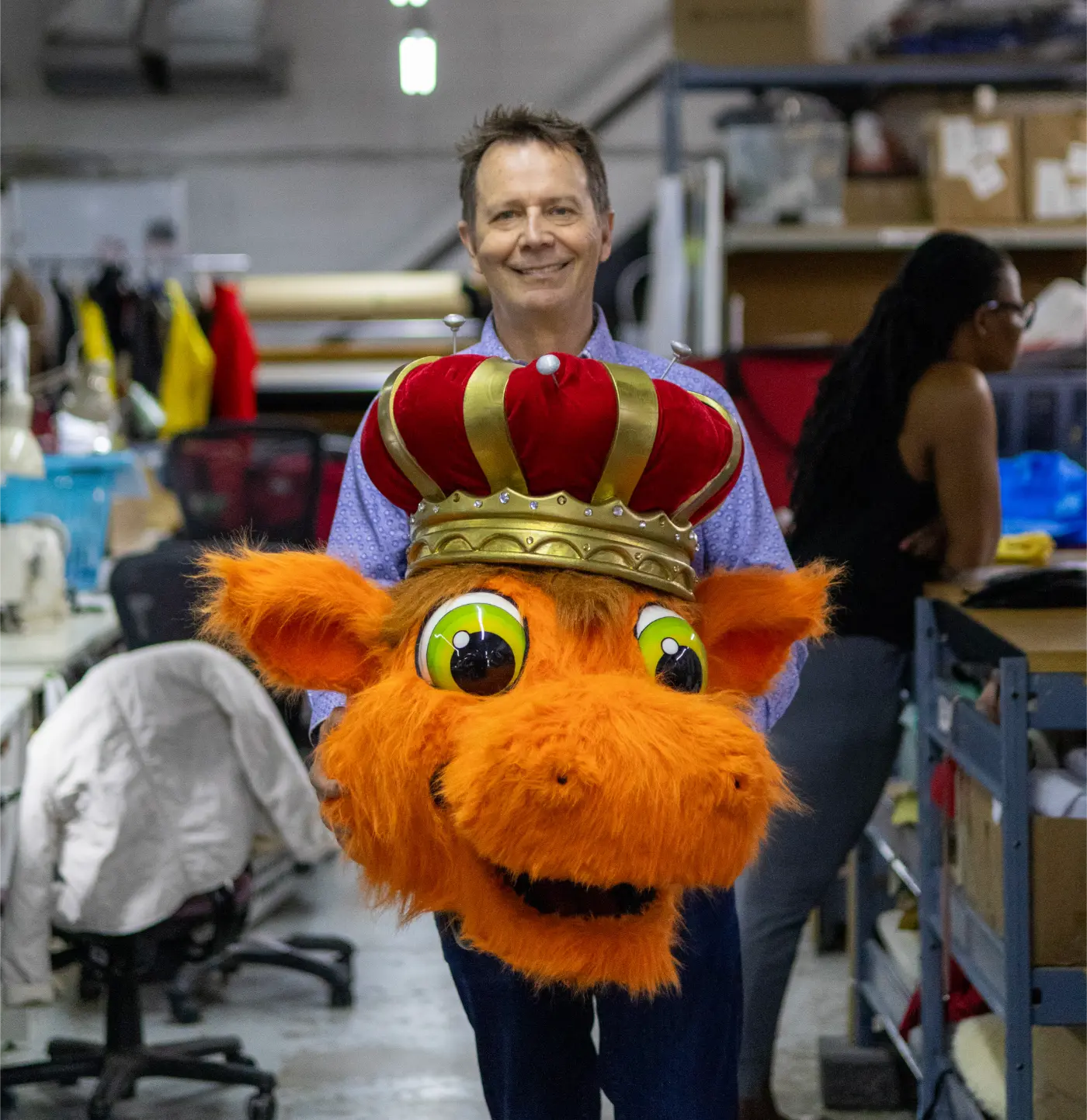
Street Characters is a Calgary-based business specializing in custom mascot costumes. What started as simply a fun idea (not a ‘real business’) for two friends, Street Characters has grown into a global endeavor with clients on every continent except Antarctica. The company has just surpassed a quarter-billion-dollar economic impact for the City of Calgary and the province of Alberta.
In 1984, Glenn Street was volunteering for the Calgary Stampede mascot program when a friend had the idea to approach the Calgary Flames about having their own mascot. The team liked the concept, which led to the development of Harvey the Hound, the first mascot in the National Hockey League and one of the first mascots in professional sports.
Street’s friend traveled often for work and asked him to be his back-up. Street, who was working as a commercial realtor, was happy to help. Soon the mascot was so popular that soon the two were inundated with phone calls from other teams for their own mascot creations. At first, their response was “No, this isn’t a real business, we are just doing this for fun.”
The calls kept coming in, and in 1987 the two became business partners and opened their doors as Costume & Mascot Design. They wanted a name that clearly described the services they offered. Two years later, Street purchased his friend’s share and became the sole owner. In 1992, he changed the name to Street Characters.
Today, ninety-five percent of Street Character’s business is export; the company has created mascot characters for about fifty percent of the NFL teams, many major baseball teams, and thousands of universities and college sports teams.
“We’re this goofy little company that no one in Calgary knows exists. Sports are much bigger in the U.S. It’s an American thing. When I’m asked how many people attend a U of C football game, I tell them we are lucky to get 3,500. In the U.S., they get 10,000 people coming to high school football games,” says Street. “Our business is much more geared to the U.S. culture than ours, but we will still have a large client base in Canada.”
Before a mascot costume is created for a new client, Glenn and his team meet with them to discuss the character. If the team name is the Eagles or the Sharks, it’s obvious what the design will be for the costume. If it’s not apparent, they spend time talking about what the area is known for and how to tie the design into that theme.
Once the character is designed and the costume built, Street Characters also provides resources for the mascot and the team. Training videos were developed years ago for the individuals hired to be the mascots, and these are still used today, along with the original mascot program management manual. The company helps the clients find the right people to fill the role and occasionally assists with any licensing and merchandising requirements, although most can now be obtained online.
“We’re this goofy little company that no one in Calgary knows exists… Our business is much more geared to the U.S. culture than ours, but we will still have a large client base in Canada.”
Street believes a strong culture and core values are critical to the success of his organization. He says the number one core value at Street Characters is “be the customer.”
“Put yourself in the customer’s shoes. If you were the customer and you were in this situation, how would you want it to be resolved? That’s how I want you to handle any situation when a customer is unhappy,” says Street.

One example of a time when the Street Characters team demonstrated this core value was with a school which was going through a rebranding. The design process had just been completed. The school advised they were sending the artwork and work could begin on the character. The costume was completed and shipped. When the team followed up, the client advised they were unable to use the character, as they had decided on another concept after giving approval. The mistake could have cost the client their job. Instead of saying no, Street asked to be sent the new artwork. It turned out to be quite similar to what had already been created so the company advised the client to ship the character back; they would make the necessary changes. It was still going to be a fair amount of work, but the costume was redone and returned to the client.
“Two months later, I was in a meeting with the contact at the school, who said to me, I have to thank you because you were in your full rights to refuse to do anything. You did exactly what we asked of you,” Street says.
“Now, if a potential client asks me what our response will be if they are unhappy with the design, guess who I tell them to call. This client is going to say, don’t talk to anyone else. Street Characters is amazing and they have your back,” adds Street.
The team today typically consists of about 33-35 people, which includes a full-time artist. Not all clients require artwork, but it is available. The two main departments consist of the sewing department and props department, which is where costume heads and feet are made, along with accessories such as shields or swords. Costume cleaning and repair services are also available.
The company has expanded so much that it also has acquired its own equipment for garment decoration, fabric pattern dyeing, embroidery, laser cutters and 3D printers, in-house services that few other companies offer. Today, Street Characters creates an average 120-130 characters each year.
The company has just opened a new division in Fort Worth, Texas, which will be focused more on fulfilling corporate client needs. It has developed a new process that will allow it to build multiple copies of one character at an attractive cost. The construction of these corporate costumes will be different from the work carried out in Calgary, where the clients are mainly professional teams and colleges.
Since characters developed for sports teams need to be athletic and active, they are difficult costumes to make because the person wearing the costume is going to be highly active for a long period of time.

“Basically, you’re putting someone in a fur bag and telling them to run around for a few hours. We have ways of ventilating them a bit, but it’s still hot.”
The costume has to be lightweight, durable, easy to maintain, safe and mobile. This is completely different from someone who is wearing a character at a grocery or other retail store.
“You need to be in good shape to be a character. The costumes are hot; you’re going to be perspiring. Some people feel claustrophobic. Basically, you’re putting someone in a fur bag and telling them to run around for a few hours. We have ways of ventilating them a bit, but it’s still hot,” says Street.
Street has always been active in the community as a volunteer. With the company now having reached a high level of success, he and his wife are able to travel several times each year. Years ago, he joined EO — Entrepreneurs’ Organization, a global, peer-to-peer network of more than 18,000+ influential business owners in 75+ countries, which he credits for his success.
“Had I not joined, I don’t think we’d be in business right now. It’s been a wonderful experience and I think anybody who’s trying to run a business on their own needs to join,” says Street.
The first years were quite lean, but Street says the company stuck to its roots. Once the word got out beyond Calgary, the company’s first big U.S. project was for the Los Angeles Kings, where Street Characters won the job over Disney and Universal Studios, and has since had a long-term relationship with the team. Today, Street Characters has worked with about 50% of the characters from different sports leagues.
“There is no organization in our business that’s even close to the quality and talent of the people we have here. As I said earlier, I’m a big believer in core values and culture,” says Street, who just returned from taking the entire team to Mexico as a thank you for reaching their targets.
What started as a fun idea has grown into a fully fledged global brand: which speaks to the power, and potential, of Calgary’s entrepreneurs.

Contributor | BRAND Magazine
Denise Summers is a contributor for BRAND magazine and the Principal of Amphora Communications, bringing over 25 years of expertise in strategic storytelling and brand development. A seasoned communications consultant, she specializes in helping organizations articulate their unique value through clear, impactful messaging. Denise leverages her extensive experience in corporate communications and journalism to explore the intersection of business strategy and creative innovation.

