


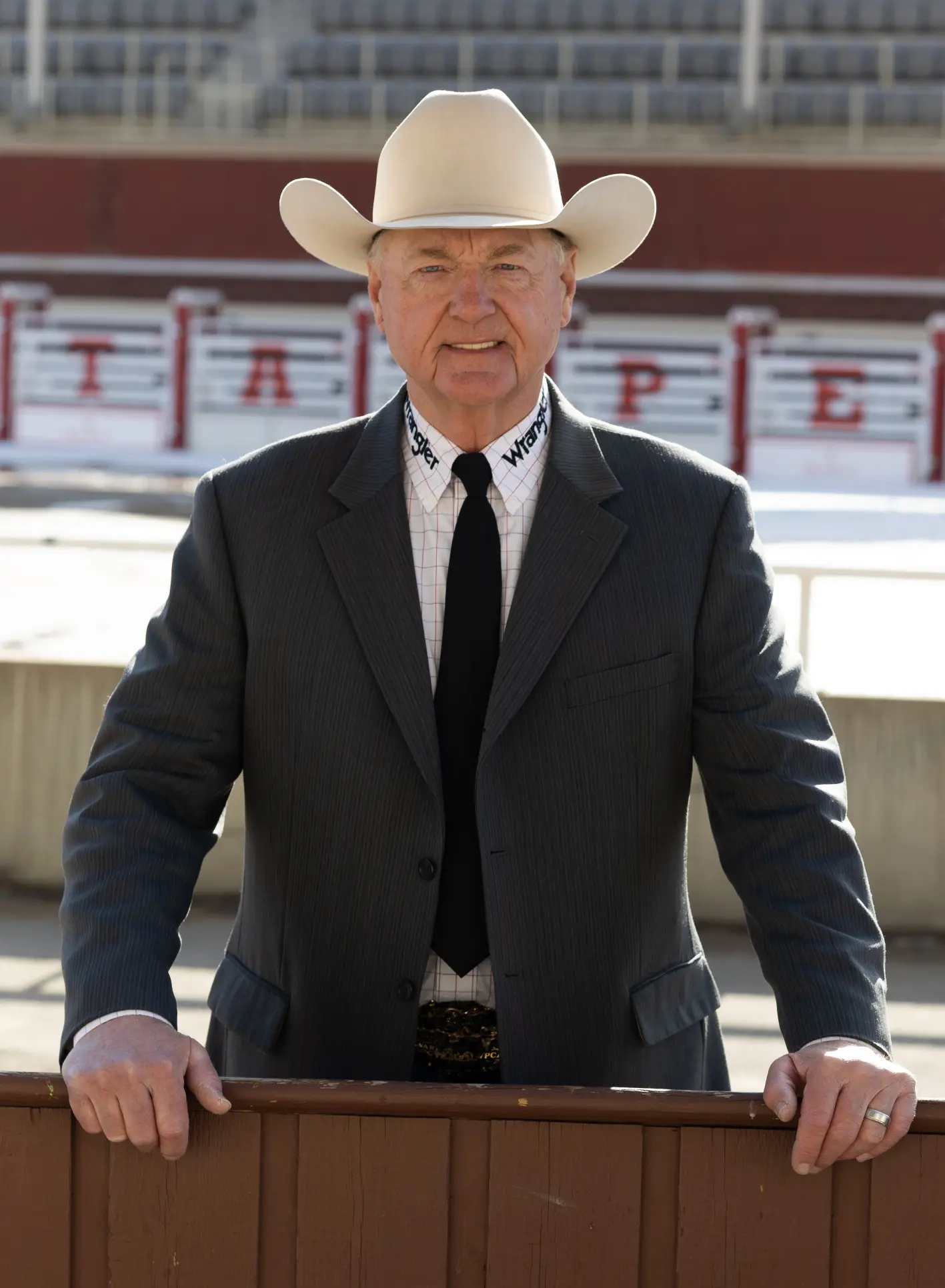
If you’ve spent any time around Chuckwagon racing or rodeo in Western Canada, chances are you’ve heard Les McIntyre’s voice. For forty years, he’s been one of the voices behind some of the biggest moments in the sport. A lot of people recognize Les’ voice before they’d ever recognize him in person. But after sitting down and talking with Les, you quickly realize the reputation and recognition don’t really matter much to him. What matters is doing the job right, something he’s built through forty years of consistency, preparation, and genuine passion for the sport.
“I still get butterflies,” he says with a laugh. “But now I make them fly in formation.”
It’s the kind of line that only comes from experience and from someone who still cares deeply about getting it right. After four decades behind the mic, McIntyre has become one of the most recognizable voices in Chuckwagon racing, calling events across Western Canada and serving as the longtime voice of the Calgary Stampede’s iconic Rangeland Derby. But while others might focus on the recognition that comes with a career like his, Les continually redirects the conversation somewhere else: the sport, the drivers, the fans, the sponsors, and the responsibility of putting on the best show possible every single night.
“It’s not about you,” he says. “It’s about the action in the infield or on the track. It’s about bragging about the drivers, giving sponsors their money’s worth, and keeping the fans on the edge of their seats.”
That mindset has shaped nearly every part of his career. When McIntyre first started announcing in the mid 1980s, he admits he had no idea what he was doing. Growing up around Chuckwagon racing gave him a natural connection to the sport, but learning how to command a microphone, structure a show, and settle his nerves took time. Going to auction school in Billings, Montana helped build his confidence when public speaking, but it was experience that would became his greatest teacher.
Before announcing became his career, McIntyre was already deeply involved in the Chuckwagon world. He spent years around the sport itself, working with horses, traveling with wagon crews, and experiencing the lifestyle from the ground level long before he ever stepped behind a microphone. That connection gave him something that can’t really be taught, as well as an understanding of the sport beyond just calling the action.
“Having been on the track and been in a wagon, having that feel and power of those horses, I think that helps make me a better announcer,” he says.
“It’s not about you. It’s about the action in the infield or on the track. It’s about bragging about the drivers, giving sponsors their money’s worth, and keeping the fans on the edge of their seats.”

Even then, confidence didn’t happen overnight. In the early years, he paid close attention to other announcers, studying how they structured races, controlled the energy of a crowd, and carried themselves behind the microphone. Over time, he stopped trying to sound like anyone else and naturally developed a style that became his own.
“Nervous would be a huge understatement,” he says of his early years. “I was scared to death.”
Those nerves eventually became fuel instead of fear. Today, even after decades in front of packed grandstands and international audiences, he still feels the pressure before a show begins.
“If I don’t get nervous, I kick myself and say, ‘Pay attention. Get ready for this show.’”
That pressure is something McIntyre still respects. Even after thousands of races and decades at the Calgary Stampede, he doesn’t allow himself to go into autopilot. Every crowd matters to him, especially the people experiencing the sport for the very first time.
“I want to do every show like it’s the very first time those people have ever seen Chuckwagon racing,” he says. “I never know who’s watching or listening.”
It’s part of what has kept his voice connected to the sport for so long. McIntyre says there’s still energy and intention behind his work, and that mentality is also part of what has kept him relevant in the sport for so long. While the sport itself has evolved dramatically, from sponsorship growth to improved safety standards and global exposure, McIntyre’s approach has remained rooted in consistency, preparation, and passion for the people involved.

McIntyre has watched that evolution happen firsthand. Over the years, Chuckwagon racing and rodeo has become more professional, more structured, and more visible to audiences outside of Western Canada. Sponsorship has grown significantly, safety standards have improved, and the sport now reaches audiences around the world through broadcasts and online coverage.
He believes that growth has changed the role of announcers too. It’s no longer just about calling races, it’s about helping present the sport properly to new audiences while still respecting the traditions that built it.
“We’re on the world stage now,” he says. “You want the sport to look good, sound good, and keep growing.”
Preparation remains a major part of the process. In the early days, researching sponsors and competitors could take hours of flipping through phone books and making calls. Now, information is easier to access but the expectations are higher, too. For McIntyre, preparation isn’t just about sounding polished, it’s about respecting the athletes, sponsors, and fans who make the sport possible.
“Focus on doing the job right first and worry about the brand later,” he says when asked about personal branding in today’s world.
Ironically, that mindset may be exactly why his own reputation has lasted. McIntyre never intentionally set out to build a personal brand. Instead, he built trust through consistency, authenticity, and a genuine passion for the sport he’s spent most of his life around.
Even now, after thousands of races and countless miles on the road, he still critiques himself after every show, replaying moments in his head and asking what could have been better.
“I’m my own worst critic,” he admits. “What can I do to make it better next time?”
Behind the microphone and packed grandstands, there’s another part of McIntyre’s story that he talks about just as highly as the sport itself: his wife, Kelly. Throughout the conversation, her name comes up naturally again and again. Not in a forced way, but in the way someone talks about a person who has truly been beside them.
“I couldn’t do it without my wife,” he says. “She keeps me focused.”
McIntyre and his wife, Kelly, have been together for over a decade. Today, it’s clear Kelly is a huge part of both the lifestyle and the career that comes with the sport. From the travel and long weekends on the road to the constant preparation and mental focus that comes with stepping behind the mic night after night, McIntyre says her support and perspective have helped shape the way he approaches the job.
“Focus on doing the job right first and worry about the brand later.”
He speaks very highly of the role Kelly has played in his career and credits a lot of his growth over the years to her input and perspective. It’s obvious he doesn’t just see Kelly as support behind the scenes, but as someone who has genuinely helped shape both his career and the way he approaches the job itself.
During the season, his weekends disappear quickly between rodeos, wagon races, travel, and preparation. The schedule is intense, often running nonstop for months at a time, but for McIntyre, it’s never just been about the work. It’s about the people around it too, the friendships, the families, the communities, and the lifestyle that comes with the sport.

“It’s a good atmosphere to raise a family in,” he says. “I love the sport. I love the people.”
For someone whose voice has become such a recognizable part of the Western Canadian rodeo scene, McIntyre remains surprisingly uninterested in fame. What matters most to him is the work itself, the atmosphere, the people, the energy of stepping up to the microphone and helping create moments fans will remember.
As for retirement, he doesn’t spend much time thinking about it.
“As long as I feel that I’m doing a good job and people are happy with the job I’m doing,” he says, “let’s keep going.”
And after forty years, Les McIntyre still approaches every show the same way he did when he first started, with nerves, preparation, passion, and the simple goal of doing the job right.

Associate Publisher | BRAND & Family Psychology Magazine
Jelena Dumka is a versatile media professional and community advocate currently serving as the Associate Publisher for both BRAND and Family Psychology Magazine. Working alongside Managing Director Danijel Slisko at Cerco Design, she plays a pivotal role in bridging the gap between high-level creative strategy and impactful editorial content.

