


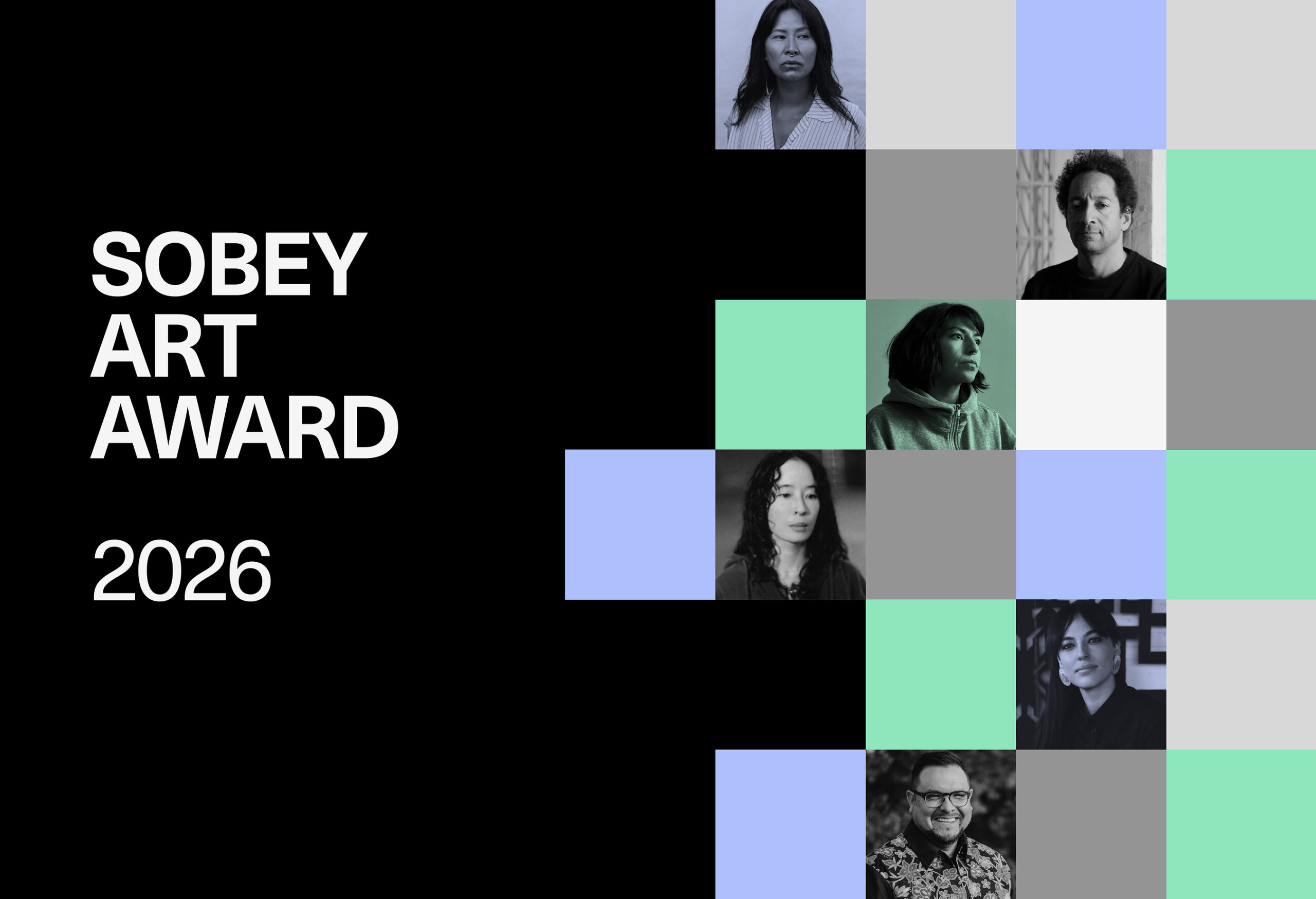
A guided read through the six shortlisted practices now on view in Ottawa, the money attached to each placement, and the date the 2026 winner is named.
The 2026 Sobey Art Award Exhibition opened on the evening of September 3 at the National Gallery of Canada in Ottawa, gathering the six regional finalists for the country’s longest-running contemporary visual arts prize in a single room for the first time this year. The public opening began at 6 p.m. in the Scotiabank Great Hall, with the artists on hand to meet visitors.
Presented by the Gallery in partnership with the Sobey Art Foundation, the show remains on view through January 3, 2027. The winner will be announced on November 14, 2026, at a celebration held at the Gallery — giving audiences roughly ten weeks to see the shortlisted work before the jury’s decision becomes public.
Six Regions, Six Finalists: Who Is on the 2026 Shortlist
The Sobey Art Award divides the country into five regions plus the Circumpolar region, and each is represented by one shortlisted artist. This year’s finalists are Melaw Nakehk’o (Circumpolar), Samuel Roy-Bois (Pacific), Audie Murray (Prairies), Lotus L. Kang (Ontario), Caroline Monnet (Quebec) and Shane Perley-Dutcher (Atlantic).
Taken together, the six practices span sculpture, installation, photography, painting, film, textiles, metalwork and land-based approaches to making. The Gallery describes the recurring concerns across the group as memory, language, land, identity and cultural tradition — themes that surface differently in each artist’s materials rather than through any single curatorial thesis imposed on the room.

Caribou Hide, Smudge Charcoal and Rotating Film Racks: The Works on View
The exhibition’s highlights, as outlined by the Gallery, give a sense of how varied the material vocabulary is this year:
- Melaw Nakehk’o (Circumpolar): Multimedia work grounded in Dene knowledge systems and a community-driven, land-based practice. It includes Mostly Human (2026), a soft sculpture made from caribou hide the artist tanned herself, alongside the paintings Sinew Theory Pink (2025) and All That Is/Shifts (2026), which honour the caribou that sustains both her community and her studio practice.
- Samuel Roy-Bois (Pacific): Sculptural and photographic investigations of the built environment drawn from the series Balloon (2025) and Sovereign (2019), examining how material encounters shape human life and how objects and spaces act as agents inside institutional and cultural frameworks.
- Audie Murray (Prairies): The mural To Make Smoke, a process-based work rooted in Métis and Cree knowledge and ceremony. Murray made the charcoal from the remnants of smudging sweetgrass, cedar and sage, mixed with locally sourced water, producing markings the Gallery calls a “container” of smudge smoke that registers labour, bodily movement and presence.
- Lotus L. Kang (Ontario): Azaleas II (2025), a kinetic sculpture modelled on a tool used to dry processed 35-mm film. It rotates according to a score built from the syllabic metre of poems by Kim Sowŏl and Kim Hyesoon, extending Kang’s interest in memory, impermanence and transformation through photographic materials and cast forms.
- Caroline Monnet (Quebec): The sculpture and embroidered works Papakinede (2024) and Eyes on the Prize (2024), which draw on construction materials including polyethylene and cement to address contemporary Indigenous lived experience, from language preservation to inadequate housing.
- Shane Perley-Dutcher (Atlantic): The Crown (2024) and Palitahamso/Proud (2023), sculptural reinterpretations of Wolastoqey basketry that merge his formal training as a metal smith with ash splint basket making, in tribute to the weavers who preceded him.
Why the Sobey Art Award Exhibition Puts All Six in One Space
Jonathan Shaughnessy, Director, Curatorial Initiatives at the National Gallery of Canada and Chair of the 2026 Sobey Art Award Jury, said the strength of this year’s presentation lies in the chance to encounter the shortlisted practices together rather than in isolation. He said the Gallery is looking forward to visitors drawing their own connections between six distinctive voices currently shaping the visual arts in Canada.
Rob Sobey, Chair of the Sobey Art Foundation, framed the prize as existing to champion artists whose work expands the understanding of contemporary art and reflects the complexity of the present moment. He pointed to the vision, originality and commitment of this year’s finalists and to the partnership with the Gallery as a way of fostering dialogue around contemporary artistic voices across the country.

What the 2026 Prize Is Worth at Each Stage
The award’s financial structure rewards more than the eventual winner, which is part of why a shortlist placement carries weight in the Canadian art market. The breakdown announced for 2026 is as follows.
| Stage | Award amount |
|---|---|
| Winner (announced November 14, 2026) | $100,000 |
| Each of the five other shortlisted artists | $25,000 |
| Each longlisted artist | $10,000 |
The number of longlisted artists and their names were not detailed in the exhibition announcement. Ticketing, admission pricing and public programming details tied to the exhibition were also not specified in the announcement.
From Frank H. Sobey’s Collection to Canada’s Preeminent Art Prize
The Sobey Art Foundation was established in 1981 by the late Frank H. Sobey, a committed collector of Canadian art. The award itself was created in 2002 and is privately funded by the Foundation, with the stated aim of encouraging new developments in contemporary visual art and advancing artists’ careers through both money and visibility inside and outside Canada.

Since 2016, the prize has been jointly administered by the National Gallery of Canada and the Sobey Art Foundation. That arrangement is what turns the shortlist into a national touring-scale moment each fall: the Gallery builds an exhibition around the finalists, and the prize announcement follows in November.
The Gallery itself was founded in 1880 and holds more than 90,000 works, including major holdings of Indigenous and Canadian art and works from the 14th to the 21st century, along with extensive library and archival collections. Its building sits on the unceded traditional territory of the Algonquin Anishinaabe Nation in Ottawa. Like other federally supported institutions designing national programs intended to reach Canadians in every region, the Gallery frames its mandate around access well beyond the capital.
Tania Willard and the Line of Past Sobey Winners
Last year’s recipient was Tania Willard of the Pacific region, whose multidisciplinary practice is rooted in Secwépemc knowledge, values and aesthetics. Her win continued a recent run of Indigenous artists taking the prize, following Nico Williams in 2024 and Kablusiak in 2023.

The full list of past winners is a compact map of Canadian contemporary art over two decades: Brian Jungen (2002), Jean-Pierre Gauthier (2004), Annie Pootoogook (2006), Michel de Broin (2007), Tim Lee (2008), David Altmejd (2009), Daniel Barrow (2010), Daniel Young and Christian Giroux (2011), Raphaëlle de Groot (2012), Duane Linklater (2013), Nadia Myre (2014), Abbas Akhavan (2015), Jeremy Shaw (2016), Ursula Johnson (2017), Kapwani Kiwanga (2018), Stephanie Comilang (2019), Laakkuluk Williamson Bathory (2021), Divya Mehra (2022), Kablusiak (2023), Nico Williams (2024) and Tania Willard (2025).
Why This Exhibition Matters Beyond the Gallery Walls
For readers who follow the business of culture as much as the art itself, the Sobey shortlist functions as a leading indicator. A placement typically moves an artist into wider institutional collecting, commercial gallery attention and international exhibition conversations — which is why the $25,000 paid to non-winning finalists is rarely the most valuable part of the recognition.
The 2026 group also underlines how much of the current conversation in Canadian contemporary art runs through material knowledge: hide tanning, ash splint weaving, smudge-derived charcoal, construction polyethylene and darkroom hardware all appear as working media rather than as subject matter. That emphasis on process and inherited technique is one of the clearest through-lines a visitor is likely to notice while moving between the six presentations.

Frequently Asked Questions
How long is the 2026 Sobey Art Award Exhibition on view?
It opened September 3, 2026, at the National Gallery of Canada in Ottawa and runs through January 3, 2027.
When will the 2026 winner be announced?
The winner will be named on November 14, 2026, during a celebration at the National Gallery of Canada.
How much does the winner receive?
The winner receives $100,000. The five other shortlisted artists each receive $25,000, and longlisted artists each receive $10,000.
Who chose this year’s shortlist?
The award is organized by the National Gallery of Canada and funded by the Sobey Art Foundation. Jonathan Shaughnessy, the Gallery’s Director, Curatorial Initiatives, chairs the 2026 jury; the full jury membership was not specified in the announcement.
What does admission to the exhibition cost?
Not mentioned in the announcement.


